

📍 Contents
1. In the abode of Badri Vishal
Like many other pilgrimages, I arrived at Badrinath by chance. It is often said that unless one is called by the gods and goddesses, reaching their Dham is never easy. But in our case, the call did not come directly from Badri Vishal; we were drawn instead by the Valley of Flowers. It was the longing to witness that valley in bloom which eventually gave us the opportunity to offer our prayers to Lord Vishnu at Badrinath.
Or perhaps the Valley of Flowers itself was only a medium through which Lord Badri Vishal called us to his abode. Maybe the mountains, the flowers, and the journey were all part of a divine invitation already written for us long before we began the trip.
It was the month of August. We knew that travelling through these mountains in the monsoon season always carries the risk of landslides and uncertain roads. At times, the journey can even turn dangerous. But this is also the season when the Valley of Flowers truly comes alive with its fullest glory. There was never really a dilemma for us — if we wanted to witness the valley at its most beautiful, we had to be there in August.
1.1 Char Dham Yatra Registration
Earlier, the Char Dham Yatra used to be a pilgrimage free from any registration formalities. However, in the aftermath of the 2013 Kedarnath tragedy, registration has become mandatory for every pilgrim undertaking the Char Dham and Hemkund Sahib Yatra in Uttarakhand. This process helps the administration manage pilgrim movement and ensure safety during the journey.
There are three ways to complete the registration:
• Online: Through the official Uttarakhand Government portal:
• Mobile App: Through the Tourist Care Uttarakhand app, available on both Android and iOS platforms.
• Offline: At various registration counters set up across the state.
To facilitate offline registration, the government has established counters in almost every major transit town and city of Uttarakhand on the Char Dham Yatra route. These centers generally operate from 6:00 AM to 8:00 PM. Most counters are located near bus stands and major travel hubs, though they often witness heavy crowds during the peak pilgrimage season.
Some important registration centers on the route to Badrinath include:
• Haridwar: Rahi Hotel (UPTDC), Haridwar Railway Station, Pandit Deendayal Upadhyay Parking.
• Rishikesh: ISBT Bus Stand, RTO Office, Gurudwara Hemkund Sahib.
• Dehradun: Jolly Grant Airport, RTO Office.
• Badrinath Route: Joshimath, Pandukeshwar, Govindghat, and Chamoli (Pankhi).
Registration mainly requires an original ID proof — such as Aadhaar Card, Voter ID, Passport, or Driving License — along with a photocopy. During the Char Dham Yatra season, it is always advisable to arrive early in the morning to avoid long queues and unnecessary delays at the registration counters.
1.2 Our Trip starting from Delhi
We boarded a bus from Delhi ISBT and set out for Haridwar. There was no intention of staying there; the plan was to move onward toward Joshimath as quickly as possible. After spending a few hours waiting in Haridwar through the night, we boarded a GMOU bus for Joshimath in the early morning and finally arrived by evening.
The bus was headed further to Badrinath, but we decided to break the journey at Joshimath and spend the night there before continuing ahead. We found a modest room for the night at a GMVN property in Joshimath.
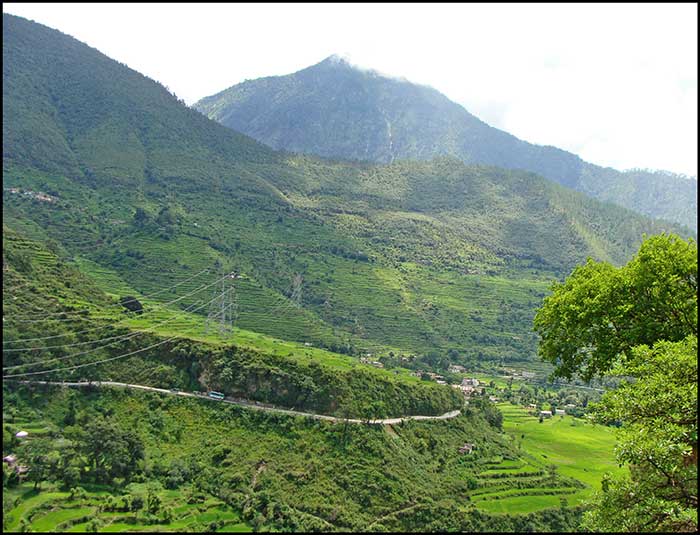
Joshimath is not merely a transit town; it is the gateway to many remarkable destinations of eastern Garhwal. From here, you can continue your journeys to Badrinath, Hemkund Sahib, the Valley of Flowers, Auli, and the Kuari Pass trek.
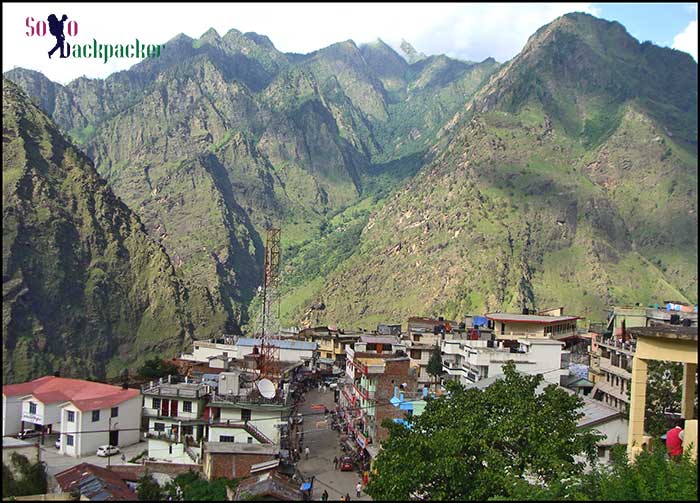
You may read my separate post to know more about Joshimath and its significance in the Eastern Garhwal Himalaya.
Joshimath (Jyotirmath) Travel Guide: Winter Abode of Badrinath Dham
2. Morning Departure from Joshimath to Badrinath
2.1 Endless wait for the final passenger
The holy town of Badrinath is about 45 kilometers from Joshimath. The next morning was cloudy, with light rain and mist covering the hills. Joshimath still looked half asleep as we walked toward the upper market road, where the shared jeep stand was slowly coming to life.
There was not even a single jeep at the stand. We waited for nearly thirty minutes before one finally arrived. And then the real drama began. The jeep had to carry exactly ten passengers before it could leave.
For a ten-seater jeep, not eight, not nine, but exactly ten passengers were needed. Every seat had to be filled before the vehicle could finally start its journey. Until then, all one could do was wait. In the early morning hours, we realized the simple rule of shared travel. Shared vehicles do not leave according to time; they leave according to the number of passengers.
Another forty minutes passed, and we were still only nine passengers. The driver kept waiting for the last passenger for almost another half hour, but no one came. What had first seemed like a small delay was now becoming a real problem. Slowly, frustration began to grow among the passengers..
That was when I suggested a simple solution — instead of waiting any longer, the rest of us could each pay an extra ₹10 along with the regular fare of ₹100. This would cover the fare of the missing passenger, and the jeep could finally leave. Everyone agreed immediately, as by then we were all tired of waiting.
And just like that, the jeep finally started its journey toward Badrinath. Sometimes, what seems like a big problem only needs a very simple solution.
2.2 Journey to Vishnuprayag: The First Prayag
Like most roads that wind through the fragile mountains like the Himalaya, the route to Badrinath changes with every season. One year, you may find a smooth and comfortable drive; the very next year, the same road may be broken or blocked by landslides. In these mountains, roads are forever being built and destroyed at the repeated intervals.
The danger of landslides has also increased steadily over the years, partly because of the continuous blasting linked to the hydroelectric projects spreading across the region. During our journey, the entire stretch leading to Vishnuprayag was covered with stone debris that had fallen from Hathi Parvat.
Vishnuprayag, situated at an elevation of around 1,372 metres above sea level, is the sacred confluence of the Dhauli Ganga and the Alaknanda River. The Dhauli Ganga descends from the Malari region, while the Alaknanda flows down from Badrinath. Vishnuprayag is regarded as the first among the five sacred Prayags of Garhwal.
An octagonal idol of Lord Vishnu is present in the temple here. This place is also believed to be the site where Narada Muni performed his penance.
2.3 Govindghat: Intersection of Pilgrimages
One of the most important stops along this route is Govindghat. From here begin the journeys to Hemkund Sahib, Lokpal Laxman Temple, Kagbhusandi Lake, and the Valley of Flowers National Park — all scattered across a mountainous stretch of nearly 35 kilometres.
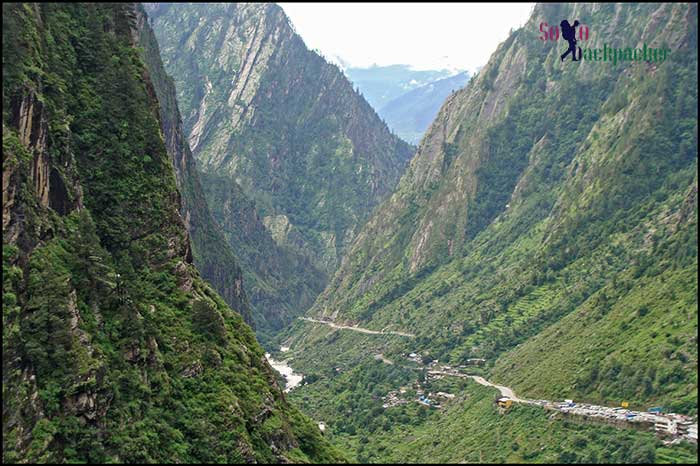
Earlier, to reach Hemkund Sahib and the Valley of Flowers National Park, you had to trek all the way from Govindghat to Ghangaria. Located around 13 kilometres from Govindghat, Ghangaria serves as the base camp for both destinations. Today, however, a motorable road continues up to Pulna, nearly 4 kilometres beyond Govindghat.
Ghangaria Travel Guide: Basecamp for Valley of Flowers and Hemkund Sahib
A separate trail from Bhyundar Village (approx 9 km on the trail to Ghangaria/Hemkund Sahib from Govindghat) leads to the sacred Kagbhusandi Lake, situated at an altitude of around 5,090 metres above sea level. Spread across a wide expanse and surrounded by flat alpine meadows, the lake lies nearly 30 kilometres away through a trek that is as beautiful as it is demanding. It is believed to be the place where the sacred conversation on the Ramayana took place between Kakbhushundi and Garuda. According to another local belief, the lake is also regarded as the most sacred place of salvation for crows.
The presence of Sikh pilgrims was clearly visible all along the route because of Hemkund Sahib. In these mountains, faith travels in many forms and belongs to no single religion.
But what surprised me even more than the pilgrims themselves were their motorcycles. I had always believed that riding through the Himalayas demanded a proper adventure bike, or at least a powerful 250 cc machine. Yet on the roads leading to Govindghat, you could easily spot humble Hero CD Deluxes, Hero Splendors, TVS Stars, and even scooters moving steadily through the mountains in remarkable numbers carrying not one or two, but sometimes three passengers.
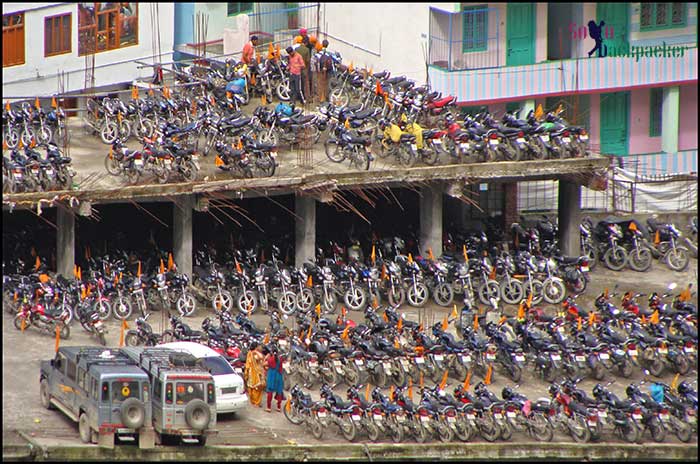
Somewhere between machine and devotion, devotion always seemed to win. These ordinary vehicles handled the difficult roads with quiet resilience — much like the people riding them. We even came across a few travellers pedalling bicycles along that rough terrain. Watching them climb those unforgiving mountain roads demanded admiration; it required not only physical effort, but a far greater strength of determination.
2.4 The Sacred Village of Pandukeshwar
The next significant settlement along this route is Pandukeshwar, situated nearly 28 kilometres before Badrinath. According to local belief, Pandu performed his penance here. The village is also associated with the birth of Nakula and Sahadeva from the Mahabharata.
Pandukeshwar stretches between Govindghat and Vinayak Chatti along the right bank of the Alaknanda River. A large number of residents here earn their livelihood through businesses linked to the pilgrimage route and by assisting in the rituals and pujas at Badrinath. During the pilgrimage season, many of them stay in Badrinath itself and return to Pandukeshwar once the season comes to an end.
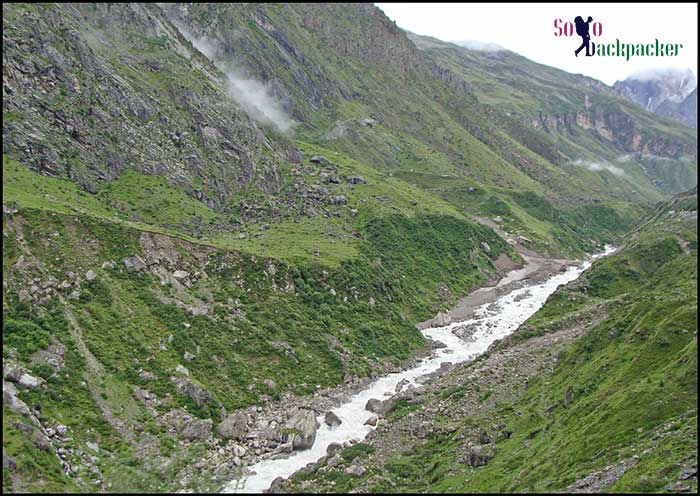
Pandukeshwar holds immense religious importance as one of the sacred sites associated with the Panch Badri temples. The Panch Badri refers to the five holy shrines dedicated to Lord Vishnu in Uttarakhand, a tradition that is further expanded into the Sapta Badri — the seven Badri temples.
The temple at Pandukeshwar has a four-armed idol of Lord Vishnu, seated in a meditative posture or yoga mudra. For this reason, the shrine is known as Yoga Badri. The temple is believed to date back to the first half of the 9th century.
3. Arrival at Badrinath
After nearly an hour and forty-five minutes of travelling along the winding mountain roads, we finally arrived near the bus stand at Badrinath, situated at an altitude of around 3,120 metres above sea level. Badrinath does not feel like a remote shrine that harshly tests pilgrims before offering its blessings. Instead, it appears as a proper and well-developed Himalayan town, quietly thriving amidst the mountains.
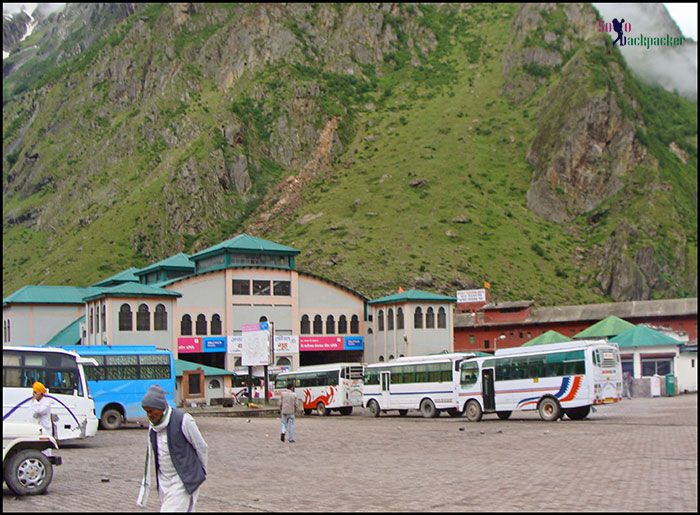
The journey from Joshimath to Badrinath was far more than a simple journey through winding roads and uncertain weather. It was a passage through landscapes shaped equally by faith, mythology, hardship, and resilience. Every halt along the route, whether it was Vishnuprayag, Govindghat or Pandukeshwar carried its own stories, beliefs, and traditional legacies flowing beside the Alaknanda River.
Badrinath Experience: Blessings From The Holy Shrine of Lord Vishnu
The mountains revealed not only their beauty, but also the fragile realities shaped by nature’s forces. Yet amidst landslides, tourist crowds, pilgrims, and broken roads, the journey continued every year with the same enthusiasm and devotion for thousands of people arriving from every part of India.
