

📍 Contents
1. Journey from Badrinath to Govindghat
Our journey to Badrinath Dham turned out to be deeply rewarding. We visited Badrinath Temple in the morning and later spent the day exploring Mana and Vasudhara Falls. In the evening, we once again visited the temple of Bhagwan Badri Vishal and sought his divine blessings. It was a spiritually satisfying experience.
Our next destination was Ghangaria, a small village that serves as the base camp for both Valley of Flowers National Park and Hemkund Sahib treks. Reaching Ghangaria itself required a trek of about 13 km from Govindghat, a small town located along the Badrinath–Joshimath highway.
Our visit to Badrinath Temple: Divine Blessings from Shri Badri Vishal
As we began our journey from Badrinath early in the morning, our first priority was to reach Govindghat as quickly as possible. We reached at Badrinath Bus Stand to get a vehicle for Govindghat. Although many buses were waiting for passengers, none of them allowed us to board. They were looking for passengers going directly to Haridwar or Rishikesh and not willing to waste two seats just for 26 km of travel. Just to make it worse, there was not a single shared jeep available at the bus stand at that time.
After waiting for some time, one bus conductor finally agreed to take us, though without seats. Eager to reach Govindghat, we agreed without hesitation. We began our return journey from Badrinath, standing throughout the ride along the winding mountain roads. Surprisingly, the rugged route turned out to be far less troublesome than we had imagined. Within forty minutes, we found ourselves at Govindghat. From there onward, the journey to Ghangaria had to be completed on foot through a long mountain trek.
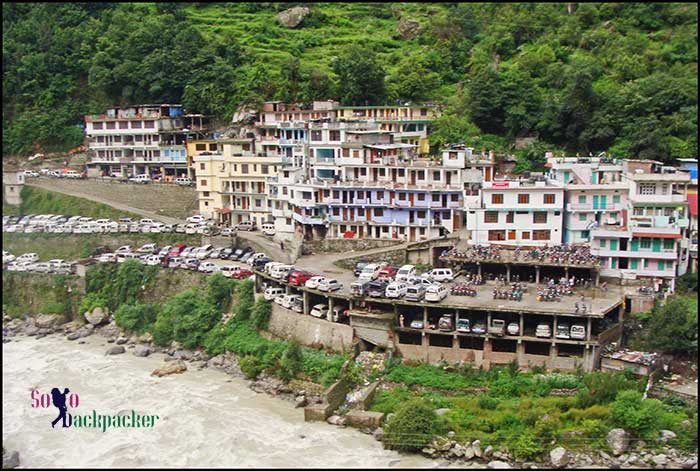
The small town of Govindghat was bustling with Sikh pilgrims. Hundreds of devotees, traveling by buses, jeeps, cars, motorcycles, and even bicycles, were arriving for the pilgrimage to Hemkund Sahib. Hotels, gurudwaras, tea stalls, and small eateries were all lively with the crowd. The parking areas built along the road leading from the main highway to the Govindghat market were packed with vehicles.
A short walk into the market leads to the Govindghat Gurudwara, located on the left side. Excellent arrangements for accommodation and food are available here. In fact, if you are ever unable to find a hotel in Govindghat, the Gurudwara ensures that you will not be left stranded for the night.
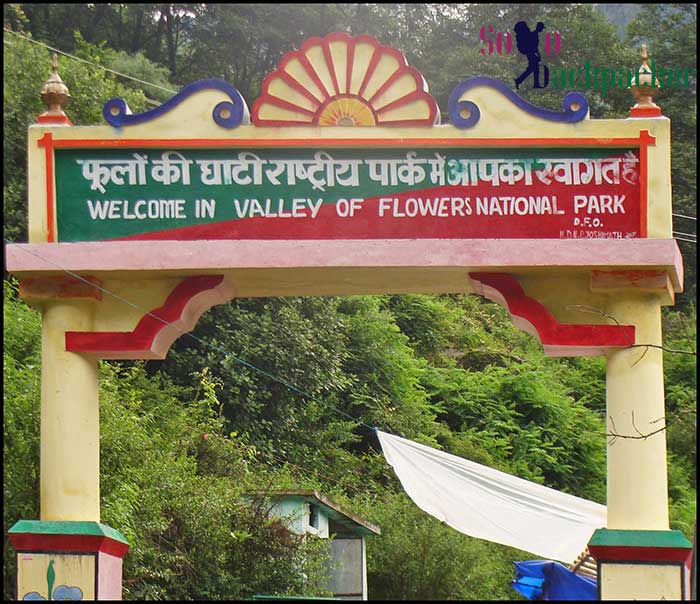
Beyond the Gurudwara, one must cross an iron bridge over the roaring Alaknanda River. On the other side stands a gate with the words, “Welcome to the Valley of Flowers.” It marks the point from where the true journey to the Valley of Flowers National Park begins.
2. Starting the Trek to Ghangaria
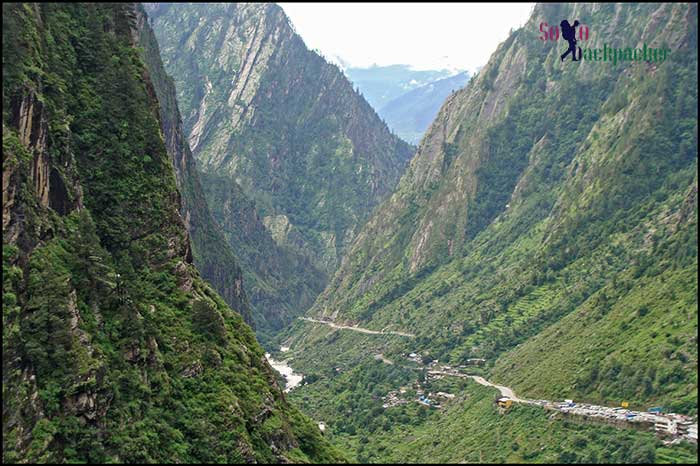
Once we crossed the gate and started trekking, we were immediately met with a steep trail. Within the very first kilometer, it became clear that the trail ahead would be both demanding and challenging.
The path was rough, uneven, and full of stones. Continuous movement of mules and ponies had turned several stretches of the trail muddy. To make matters more difficult, both of us were carrying heavy backpacks. It was clear this was not going to be a pleasant experience.
Many fellow travellers advised us to leave some luggage at Govindghat, where several shops offer luggage storage facilities. We should have listened to their advice, but overconfident, we believed we could manage it on our own somehow.
Barely after 2 km of trekking, it became evident that at this pace we would not be able to manage the journey. We stopped frequently to rest and catch our breath. At this rate, it seemed likely that darkness would fall before we reached Ghangaria. We were not novices on the trail, but we had underestimated the burden of our heavy backpacks.
That was neither the first nor the last time we miscalculated the weight of our load during a trek. It had happened earlier at several places, and it repeated again on our other journeys to Ladakh, Kedarnath, and elsewhere. In an effort to make our travels a bit more comfortable, we often end up packing our backpacks with so many clothes and items that walking becomes difficult.
With experience, I am slowly learning how to pack light. These experiences have helped me manage my luggage better, and now I enjoy my treks in a much easier and more comfortable way.
Travel Guide to Eastern Garhwal Side of Uttarakhand: Badrinath, Valley of Flowers & Beyond
Interestingly, on the trail, a mule owner kept pursuing us to hire a mule from the very beginning. But we were determined to reach Ghangaria on our own. He had been following us along the route, silently observing our struggle. When it eventually became clear that we could not continue any longer, he approached us again. This time, we negotiated the price and agreed on a reasonable fare.
Hiring a mule turned out to be a good decision. While Nidhi rode the mule with both bags, I could trek freely without any load on my back and maintain a steady pace. It made the journey easier and less tiring, allowing me to focus more on the natural beauty all around me.
2.1 Pulna Village and Registration Center
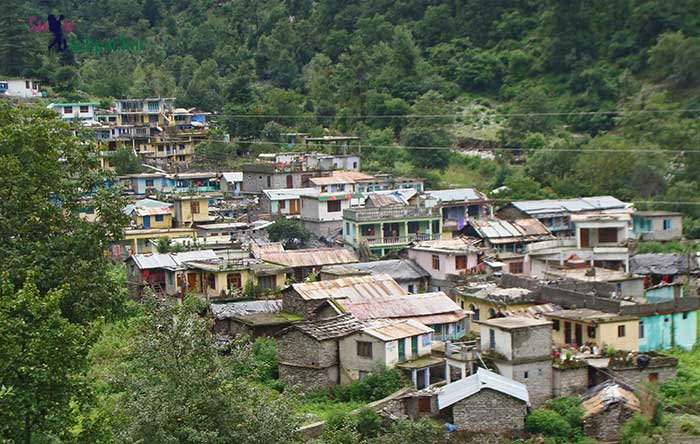
Moving on, we reached Pulna. I still remember when it was just a quiet little village that most trekkers passed without noticing. Today, it buzzes with the cheerful chatter of travelers, thanks to the shared jeeps that now operate from Govindghat to Pulna. If you wish to stay there, home-stays are available in Pulna.
After crossing the river bridge at Govindghat, you need to walk for about half a kilometre before you see shared vehicles lined up along the roadside. They usually charge around ₹50 per passenger for the ride to Pulna. Getting the shared jeep to Pulna saves you from walking 4 km and cuts down the trek by at least one and a half hours. From Pulna, you only have a 9-kilometre trek to Ghangaria.
Just beyond the Pulna jeep stand is a mandatory Registration Center where every traveller must register before continuing the trek. From here onward, the journey becomes even more exciting, with breathtaking views all around.
2.2 Food, Shelters, and Facilities on the trail to Ghangaria
The trekking route has improved a lot over the years. Much of the rough trail has now been replaced with interlocking stone pathways and protective railings along the sides.
Tin sheds appear at regular intervals along the route, providing protection from rain and strong sunlight. Benches have also been placed at different points where tired trekkers can rest for a while and regain their energy.
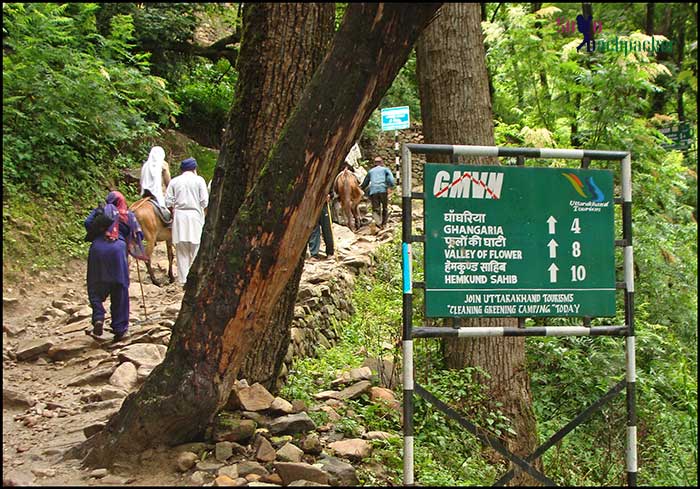
Food stalls and small eateries appear frequently along the trail. Even in such remote forested surroundings, you can find tea, noodles, snacks, soft drinks, and proper meals without much difficulty. The prices are naturally a bit higher than usual, but considering how difficult it is to carry supplies to such a remote area, they feel completely reasonable.
Along the trail, we came across countless elderly Sikh pilgrims dressed in traditional attire, their saffron and blue turbans creating a striking contrast against the grey mountains and green forests. Some walked on through light rain wearing plastic ponchos, while others covered the difficult trail barefoot in pure devotion.
What touched me most during the journey was the spirit of the people along the trail. On this steep mountain path, everyone encouraged and supported one another, regardless of age, language, or background. At many places, volunteers offered biscuits and glucose water to tired people passing by.
2.3 Scenic Beauty Along the Trek
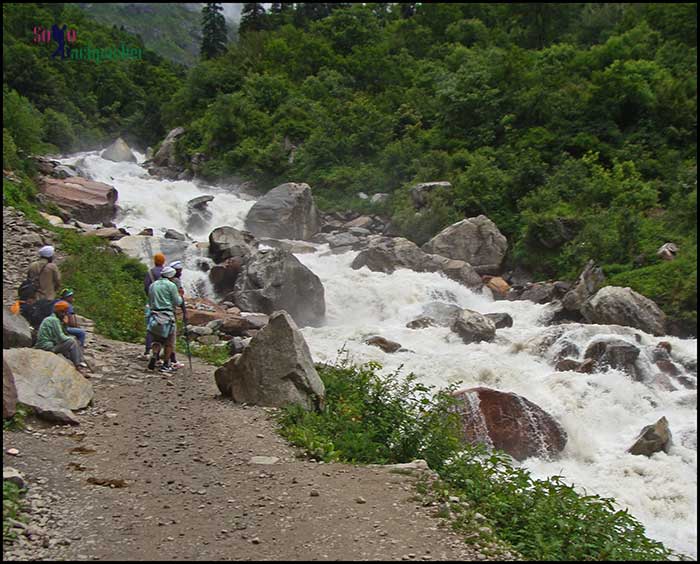
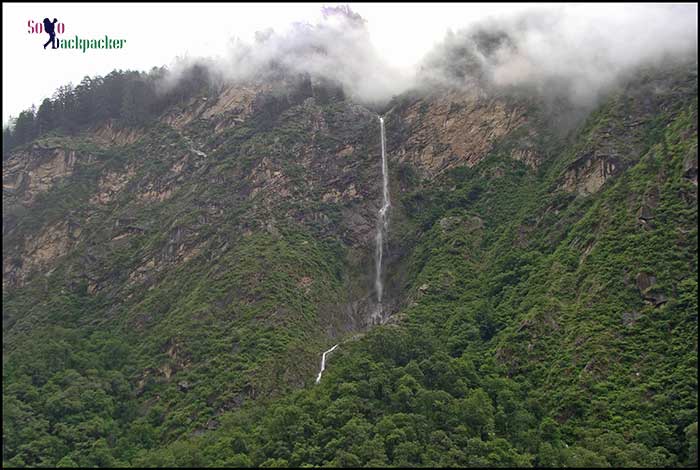
While climbing toward Ghangaria, if the trek tested the body, the scenery healed the mind. Clouds drifted slowly around the towering mountains, appearing and disappearing in an endless game of hide-and-seek. Waterfalls poured down steep cliffs from incredible heights. Beside the trail, the roaring Lakshman Ganga River flowed tirelessly, accompanying travelers through much of the ascent.
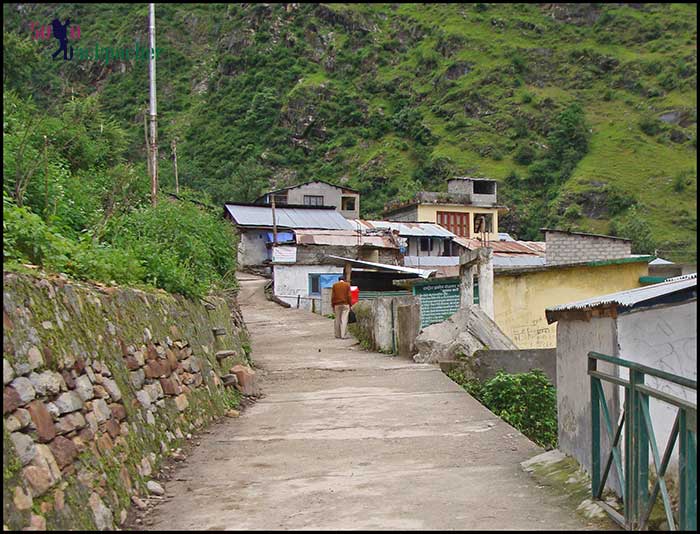
About halfway between Pulna and Ghangaria lies Bhyundar Village. Small and peaceful, it still retains its traditional mud houses and raw natural charm. From here, a separate trail leads toward the mystical Kagbhusandi Tal.
We stopped from time to time for tea and snacks before moving ahead again. Not everyone, however, was trekking on foot. Mules and palanquins were a common sight along the route. In fact, many young travelers in their twenties also preferred riding mules for certain parts of the climb.
Free from the weight of my backpack, I could walk far more comfortably and maintain a faster pace. Most of the time, I remained only fifteen or twenty minutes behind the mule carrying Nidhi along with our backpacks.
3. Reaching Ghangaria
The final three kilometres turned out to be the toughest part of the entire trek. The trail turned sharply steep and walking a few steps felt difficult. Breathless and completely worn out, we kept pushing forward until we finally made it to Ghangaria that afternoon.
While the hike to Ghangaria is absolutely beautiful, arriving there feels far less romantic. It was a small settlement crowded with hotels and guesthouses mainly catering to pilgrims and trekkers, so the place itself does not feel particularly charming or scenic.
Just outside Ghangaria, there is a helipad offering regular helicopter services to and from Govindghat. Nearby, luxury Swiss tents provide a peaceful and comfortable stay for travelers willing to spend a little extra. In many ways, apart from the stunning mountain views, these tents are perhaps the only place in Ghangaria that offers a touch of elegance and comfort.
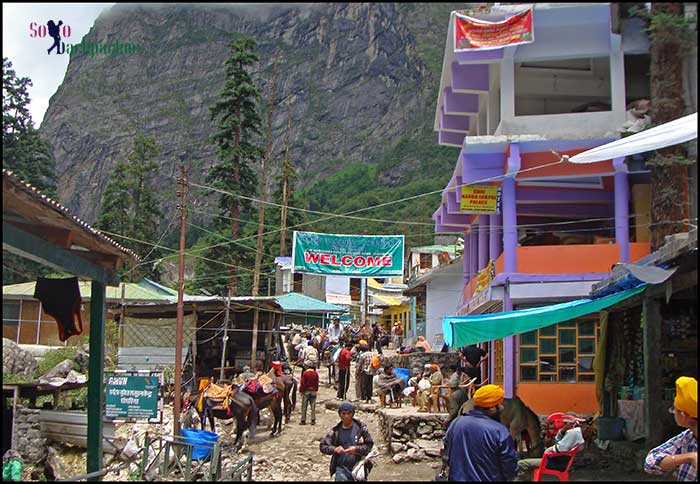
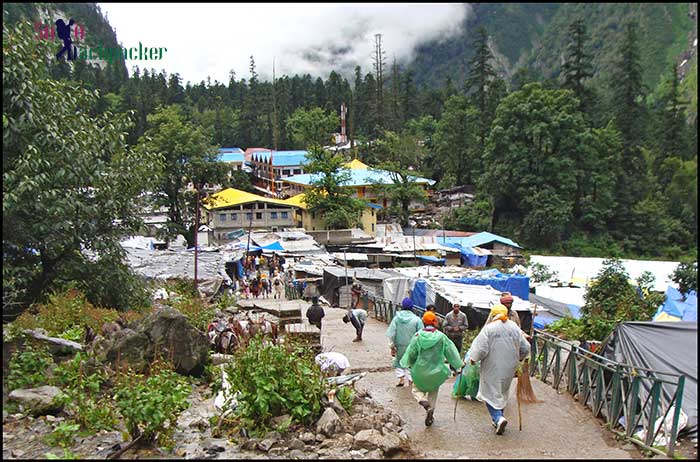
As we finally stepped into Ghangaria, the mountain magic faded for a moment. We were greeted by piles of mule dung and the strong smell of animal waste running down the path. Beyond that stood a chaotic jumble of hotels, messy shops, and haphazard houses. It is a noisy, crowded village built purely to serve the endless stream of pilgrims and trekkers.
4. Accommodation in Ghangaria
After reaching Ghangaria, I headed to the GMVN Tourist Rest House, where Nidhi was already waiting for me. Apart from the Swiss Cottages, the GMVN property seems to be one of the few reasonably comfortable lodging options in the village. I had tried booking a room online earlier, but by then everything was already fully booked. I also enquired about availability on arrival, but no rooms were left.
During the peak season, the crowds are so huge that finding a room can be a real challenge. If you are traveling without prior reservations, it is better to start the trek early in the morning from Govindghat/Pulna so you can reach Ghangaria before the evening crowds begin to arrive. Arriving in Ghangaria early gives a much better chance of finding a decent accommodation.
Fortunately, we found a good room in a hotel just across from the GMVN guesthouse. As soon as we stepped inside, we went straight for a bath. Nothing feels better than a bucket of water after a long mountain trek. After that, we had some lunch, and then tiredness completely took over. We fell asleep almost immediately, too exhausted for anything else.
Most travellers end up staying in Ghangaria for at least three nights: the first after reaching, the second following a visit to the Valley of Flowers, and the third after the trek to Hemkund Sahib. Since overnight accommodation is not permitted at either destination, Ghangaria remains the only viable base camp for night stay.
Tourism infrastructure in Ghangaria has grown rapidly over the years, offering plenty of accommodation options for pilgrims and trekkers. Almost every building in the village now serves as a guesthouse, lodge, or hotel in some form. Just keep your expectations low: nothing here is stylish, and almost every place looks a bit shabby and dated.
5. Exploring Ghangaria Village
By evening, we felt refreshed enough to explore the village. Ghangaria, also known as Govinddham, is the last inhabited settlement in the valley. Beyond this village, the trails only serve as day hikes to either the Valley of Flowers or Hemkund Sahib, and everyone is required to return to Ghangaria before dark.
For most of the year, however, the village remains completely deserted. From November until late May, the entire region is buried under deep snow, forcing both locals and shopkeepers to shut down and leave Ghangaria entirely.
At the edge of the village, the Pushpawati River meets the Lakshman Ganga River. The Pushpawati flows down from the Valley of Flowers, while the Lakshman Ganga descends from Hemkund Sahib. Just beyond Ghangaria, the two rivers merge and continue as the Lakshman Ganga, which eventually joins the Alaknanda at Govindghat.
Travel Guide to the Valley of Flowers: A Paradise on the Earth
The Gurudwara at Ghangaria is among the most active spots in the village. Pilgrines come and go throughout the day, while the langar serves hot tea and meals continuously. The presence of the gurudwara ensures that no visitor is left without shelter, even during the peak rush of the pilgrimage season.
By the time we reached the Gurudwara, my trekking shoes were falling apart. The sole on one shoe had actually started to tear. Fortunately, there were a few cobblers sitting right outside the Gurudwara who repaired shoes in a quick manner.
One surprising discovery in Ghangaria was a small cinema hall meant for mule owners, labourers, and palanquin bearers, where films are shown every evening on a television set. A handwritten notice board outside displays the movie scheduled for the day.
The GMVN complex in Ghangaria features an eco-documentary center run by the Forest Department. They screen a short, informative documentary on the Valley of Flowers every day, usually in the late afternoon or evening.
After walking around the village for a while, we headed back to our hotel. By that time, we were starving. We had dinner at a local dhaba and went straight to bed. Exhausted but excited for the next day’s adventure, we fell asleep dreaming about the Valley of Flowers.
6. Connectivity and Essential Facilities
Despite its remote location, Ghangaria does offer a few essential facilities:
6.1 Helicopter Services to Ghangaria
Helicopter services operate between Govindghat and Ghangaria for both one-way and round-trip travel. The aerial journey takes nearly 10 minutes to reach the Ghangaria Helipad from Govindghat. The approximate fare for a return ticket is around ₹10,800 per person.
Helicopter operations in this region are highly dependent on weather conditions, and delays or cancellations are quite common during unfavorable weather.
Pilgrims and travelers should note that the only authorized platform for booking helicopter tickets for Hemkund Sahib is the IRCTC Heli Yatra portal.
Official Helicopter Booking Portal to Ghangaria: IRCTC Heli Yatra
6.2 Mobile Connectivity at Ghangaria
Airtel and Jio networks work quite well in the village and, apart from a few blind spots, even extend into parts of the Valley of Flowers. Earlier, there was no mobile connectivity at all, so travellers either carried BSNL SIM cards or depended on local PCO booths to make calls—often paying as much as ₹20 per minute. Even now, despite relatively stable Airtel and Jio coverage, PCO services still exist and typically charge at least ₹10 per minute for calls.
6.3 Electricity at Ghangaria
Electricity in Ghangaria remains limited, typically available only for a few hours in the morning and evening. Charging phones and cameras can sometimes be a challenge. Hotels also charge an extra fee for a bucket of hot water.
6.4 ATM Facilities/Card Payments at Ghangaria
ATM and card payment facilities are not available—not just in Ghangaria, but often even in Govindghat. Although there is an ATM in Govindghat, it is strongly advisable to withdraw enough cash in advance, preferably at Joshimath or Badrinath, before starting the trek.
7. Important Things to Know Before Visiting Ghangaria
Govindghat stands at an altitude of approximately 1,828 meters, while Ghangaria rests much higher at around 3,048 meters above sea level. Fortunately, shared taxis now operate up to Pulna, reducing the trekking distance from 13 km to about 9 km.
Keep your backpack light—the steep ascent is demanding even without extra weight. You can safely leave additional luggage at Govindghat storage facilities before starting the trek.
Carry enough cash. ATMs are unreliable and digital payments often fail due to weak network coverage. Prices are higher due to transport constraints, and even hot water is usually charged separately.
Despite the remoteness, mobile connectivity is fairly stable. Jio, Airtel, and BSNL all provide usable coverage in the village, though with occasional blind spots.
Always carry a raincoat or poncho—weather changes rapidly in the Himalaya. Extra socks and innerwear are essential, as moisture makes drying clothes extremely slow.
More than anything else, Ghangaria teaches patience. The journey is exhausting, the climbs are relentless, and the facilities remain very basic. Yet, somewhere amid the drifting clouds, cascading waterfalls, and dense forests, you discover a quiet determination shared by everyone around you. In those moments, the physical hardship slowly fades, leaving behind an experience that feels deeply rewarding and unforgettable.

Excellent blogpost. However, there have been drastic changes in the last two years in the area. I visited both Valley of Flowers and Hemkund this year only (August 2022)
To start with Helicopter charges have become very affordable. It takes Rs 2895 per head for one way ride from Ghangharia to Govindaghat and vice versa. While returning back we took the journey. It is 10 minutes ride, saves lots of time. It starts in the morning hour. We reached Govindaghat by 8:30 a.m. If you have a car at your disposal, practically you can reach Haridwar the same day evening.
Portar from Govindaghat takes around Rs 1000 to drop your luggage at Ghangharia. Individually they carry large number of luggage. Our porter carried three large rucksacks, two small bags, and a full carton of Bisleri (packaged water is still very costly, we had carried the carton all from Haridwar in our car!).
Secondly there are all kinds of Hotels from Top class to medium to average to free are available at Ghangharia now. Hot water still takes time but some hotels have geyser facilities too. A wide variety of food are available. We had practically a gastronomical tour. Our hotel cook (Himalayan Holidays) cooked whatever we ordered, including some local food.
Rescue operations by the Uttrakhand Government is pretty fast too. One of our trek members had a major fracture in his leg during Valley of Flowers tour. He was brought down, given basic treatment and airlifted to Govindaghat with 1 hour. Mind it, he was only person travelling in that helicopter, yet he was charged only his individual fare.
We had a car at our disposal at Govindaghat, so we did not any more Government service to reach to nearest hospital. In case we did not have so, he would have been taken to nearest major hospital by Government ambulance.
Thank you for the latest update. A lot has been changed indeed. The area is more tourist friendly now, thanks to the pilgrims going to Hemkund Sahib. Hope the Valley of Flowers will sustain the tourist onslaught in this area. 🙂
How long does the 13km trek take to climb?
5 hours with normal pace.
Hi I’m planning my trip VOF on 9th august via bike. I want to know if i can take my own tents and camp somewhere there in ghangaria.
You can pitch your own tent at the outskirts of Ghangaria. But the camping culture is not so popular in the region. I didn’t find people pitching their own tents. As of now, Ghangaria has plenty of accommodation. But, soon all the hotels and guesthouses may be shifted from Ghangaria by the forest department, the recent developments indicate.
Hi, Thanks for the great information.
I am planning to reach Govindghat by 10th aug evening. Plan is visit VOF & Hemkund sahib in next 3 days. I like to do solo travel and take the help of mule if available.
My biggest worry was about accomodation in Ghangaria for 3 nights. Do i have to go with a trekking agency or i can get the accomodation there? Can you share if you have any contact numbers for accomodation, to avoid surprises at the last minute.
Hi, If you can book an accommodation in advance, then book it however, you can find an accommodation after reaching Ghangharia. In the worst case, you can definitely find a shelter in Gurudwara at Ghangharia village.
Hi ,
I am planning to visit VOF in mid Aug with parents(driving from delhi to govindghat). Could you please guide if it is safe to visit VOF in this season.
we are not planning to take any package, will enough stay facilities be there on adhoc basis or should we pre book everything.
Also at few sites I read that govindghat to Ghangaria is 13 kms out of which few distance can be covered by local jeeps.Is it true?if yes what is the charge?
Also about the helicopter facility from govindghat to ghangaria,what is the cost and facility to avail it?
Thanks much in advance!
Mid August is perfect to see the wild flowers at full bloom, but the rains are unpredictable. If it rains heavily, then you can expect landslides and road blockages, otherwise it’s perfectly fine to visit during this season also. Since you are traveling with the parents, it’s better to arrange accommodation in advance. No need to book any trek for VOF or Hemkund Sahib, since the trails are easily navigable. You can try to book GMVN Property online at GMVN website.I don’t have any idea about the motorable road, but helicopters do fly from Govindghat to Ghangharia in good visibility conditions subject to the weather. Helicopters can be book on the spot near the helipad in Govindghat. The one way fare is approx Rs 3000 per person.
can u please provide the hotel name and contact number so we will easily book it?
Hi, I don’t have the name and number. But, just check on the GMVN website. I think you can book their property at Ghangharia online.
am planning to visit Hemkund sahib and VOF in first week of july 2019
Please advise if thats good time to go ..
we will be travellingf rom badrinath to Govind ghat .
Pls advsie how many days to keep for ghagaria -VOF -Hemkund sahib to return to Govind ghat
Hi, Rainy season is prone to the landslides and frequent road closures, though not necessarily. That is the best time to visit VOF, as you can see the flowers at full bloom, a lot of green nature and many cascading waterfalls. If you have made up your mind, just go ahead and enjoy your trip. You need at least 4 days for Govindghat-Ghangharia-VOF-Hemkund Sahib-Govindghat trip.
Could you please share the detail of the hotel where you have stayed at Ghangharia
There are plenty of hotels and guesthouses. A GMVN (Garhwal Mandal Vikas Nigam) property is also there.
Hi Dear,
Thanks for the excellent information. I am going to both V.O.F and Hemkund Sahib in July. We will reach Govindghat at 1-2pm. Can we start the trek to Ghanghaira village on the same day as we limited time.
Hi, I think it’s better to spend that day at Govindghat. Start your trek next day from Govindghat.
nice blog
How to get travellers for the trip, as I like to travel but it’s always better to have some travellers with you. I m from delhi and drive my car to moat of the places. Travelling to VOF in Sept by my own car. U have traveled so many places…what’s your job 😉
I work at the airport. Earlier I was in Delhi, but now at Guwahati Airport. If you need travel companion, better to use meetup or facebook forums, you may get a company. Else, enjoy alone. VOF is perfectly fine for solo trip. Happy Travels. 🙂
Hey shipra..i am also planning to travel solo to vof in first week of august..lemme know if you are willing to join
What do u think we should carry from govind ghat to ghaghara and VOF. We will be taking mule. How much winter cloths are needed. My plan is on 3rd Sept 2018. Which are the near by areas we can see, if not opting for hemkund sahab.
Hi, since you are riding a mule, you can choose to carry whatever you wish for the trek clothes, raincoats, dry fruits, trekking shoes etc. You can keep your luggage at your hotel room for day kong trek to VOF or Hemkund. Unfortunately, except VOF and Hemkund, you can’t plan anything else from Ghangharia village. Bhyundar valley is another option, but that’s a trek again, and from Govindghat only. 🙂
your details really useful for any one who wishes to undertake this journey.thank .you very much
thank you very much for this beautiful blog. very useful information
I m travelling solo..so please tell me important things i should keep in mind from girls point of view.
Hi, you should read this for my personal opinion:
http://solobackpacker.com/2014/09/16/challenges-of-solo-travel/
All the information’s are really helpful..Thanks… Appreciated
I am very pleased to read this. I felt I was seeing this all with my own eyes. Thanks. What was the dates you made this trip?
Thanks again.
It was in the 3rd week of July.
Hi,
We(me ,my brother, my wife and 5yrs old child) are planning to VOF in 12th August 2017.Is that time is ok to trek VOF? What about the road condition and rainfall. Accommodation availability? 1st day Starting from haridwar to joshimath, 2nd Joshimath to Ghangria , 3rd Ghangria to VOF and return back to Ghangria, 4th Ghangria to Hemkund and return back to Ghangria 5th day Ghangria to Badrinath if possible or return to Joshimath, 6th day Joshimath to Haridwar.
Hi, daywise itinerary looks good, and this is the perfect time to visit the valley. Rain is frequent, but natural beauty is unparalleled in the month of August. You may keep one buffer to avoid any inconvenience due to the rain or landslide. If possible, try to book GMVN property at Ghangharia online, else just go there. You will get many options. And, take care of 5 years old kid, he/she may not be able to cope up with the steep hike during Hemkund Sahib trek. However, VOF trek should be okay. Have a nice trip 🙂
Really helpful. Thanks
Very informative and helpful. 🙂 Can you tell what was the approximate cost of your whole trip (all 8 days)?
Hi, Including Badrinath and Mana Village, you can complete Valley of Flower Trek in approximately Rs 8000. YHAI sometimes organize this trek at really low cost, less than Rs 5000.
Loads of information.. found everything i was looking for.. Thank you very much
Can you please update me whether MTNL Prepaid or Prepaid networks are available at Ghangaria.
Both.
Thanks for the update.
Hi…
Nice Pics and article is wonderful.
We are planning to visit valley of flower on 11th august,2016. Is it possible to track Govind ghat to valley of flower and back to ghangaria for night stay in a one day ?
Regards
Sandeep Pandey
Hi, it’s not possible. You are supposed to leave Valley of Flowers by 3 PM to be more comfortable. And the hike from Govindghat to Ghangaria is approx 13 kms. 🙂
Hi…
We r 7 persons move to valley of flowers in August 2016, we need some hotel/camping side contact no.. can we make own tenting? if so, then what is the procedure for getting permission
Hi, there are many open areas, where you can place your own tent. Near the helipad, there are some tents of private tour operators. Unfortunately, I don’t have the contact number of any hotel.Check out this number of VOF park office +91-1389-222179. They may guide you on the camping permission.
thankyou so much for this valuable information..
Hi there,
Thanks for sharing your experience. I am planning to visit VOF in second week of this August with my parents. I would prefer to book an accommodation in Ghangaria beforehand. The GMVNL one is already filled. Could you please share any contact number/email id of other accommodation(s) available there?
Hi, There are plenty of accommodation plus one gurudwara. But, unfortunately, I don’t have any contact number. You can try to contact VOF office at +91-1389-222179. They may help you with reliable information.
Excellent post and very informative.
Anyone interested for VOF Bike-Trek in mid or late August.
Bike ride from Rishikesh – Govindghat then trek to VOF.
Dear Sir,
Could you please guide, which place did you stay at Ghangharia or suggest good hotels.
Regards
Sumeet
Hi, you can plan to stay at GMVN Guest House in Ghangharia. Book it online and well in advance at GMVN website. There are many more hotels available at Ghangharia. You can book them on the spot. and, in the worst case, if you don’t get any accommodation, Gurudwara is always there to help you. You can book rooms at the Gurudwara also.
Hello, your blog post is helping me a lot to plan our coming trip to VOF. What I get to hear from people is that the condition in Govindghat is not the same after flood. The gurudwara at Govindghat was badly affected in flood. So, is it restored now? What about the other gurudwara at Ghangharia? The GMVN guest house is full booked, hence, we are counting on gurudwaras as our last option. Thank you so much for such a detailed account. 🙂
Hi, that’s true. But there are lot of other accommodations available at Govindghat and Ghangharia, so Gurudwara is not the only option. Accommodation is not a matter of concern unless you are trekking with kids or very particular about the rooms. You will get something to spend the nights. There is a new route opening to VOF. Heard it’s more scenic than the original one. Enjoy your trip. 🙂
Hi, I was searching for camping sites i.e., self camping sites anywhere in Ghangaria, but unable to find any info on this. Does it mean that camping (with own tents) is not allowed or not possible due to the weather it is not possible in Ghangaria.
Hi, I don’t have an authentic information, but there are lot of camping sites outside the village, especially around the helipad. Some tour operators also have their tents near the helipad area. I think, you can camp anywhere outside the village, except the area of Valley of Flowers National Park. Ghangharia village is very congested and its not possible to camp inside the village.
Hi..is there toilet facilities (hot water especially ) available in Ghangharia if we choose to stay in self made tents ?
Nope..You have to plan for the vast open space. Alternatively, ask to any hotel after your arrival. They can provide you hot water. 🙂
Hi
Its really good to see your post about VOF and other places which you have mention in your post but i want to know about VOF that mid aug is really good time to visit there if you could give me any advise reagarding span of time and any other useful information which is related to visit there.Especially want to know about road condition
Tnaks & Regards
DEEPAK
Mid August is the best time to visit VOF. You can see flowers in full bloom after the rain plus lot of greenery. However, that area is prone to Heavy Rain and Landslides in the month of July-August. Have 1-2 spare days in your itinerary.
Hi,
Nicely explained. It’s good informative. Everytime i read about valley of flowers, feels like i am being there. feels excited to visit. I would like to visit, valley of flowers, hemkund and badrinath from 18 july to 23 july 2015 from badrinath. I am coming alone from south india. Looking to join some travel groups and visit this extraordinary place. Feeling thrilled.
Thanks,
Siva….
9846974827
hi,, when did u take this trek,,,?? i m planning to go in aug 1st week
Hi, your timing is excellent for VOF trek. We went in the second week of August. In the month of August, you can expect to see a lot of flowers in full bloom. Though not necessary, but there are chances of the landslides due to heavy rain in the entire area. Be prepared for road blockage and have 1-2 extra days in your itinerary. Enjoy and have a great trip. 🙂
The article was excellent n will the vof be open in the beginning of July?
Thank you and yes, VOF is already open and will be open in the beginning of July. However, if you can postponed it till the mid August, then you will get the best experiences of the valley. July and August are more prone to the heavy rains and the landslides. Just be prepared with 2 extra days, if any road gets blocked.
Hi dear
It is very nice to read a good guidelines who wanted to go to Hemkund Sahib and Vally of flowers. I am planning to go to these places in the monnth of Sept 2014. Will be this month OK for the vally of flowers and Hemkund Sahib. I am going with my spouse so please inform accordingly.
Deelip Pawar
Mumbai
9892518569
Hi,
September is a good month to visit Valley of Flowers and Hemkund Sahib. You can expect less rain and may be, no landslides. But, Entry to Valley of Flowers is not permitted because the broken bridge after Ghangaria. So, check that before planning for VoF. However, Hemkund Sahib is easily accessible.
Have a nice trip.
Thanks Avanish. Your thoughts helping me out plan itinerary. Especially care that should be taken.
Thank You.
– Megh
Have a nice trip 🙂
Hi Ashish, Unfortunately I do not have any contact number of the hotels at Ghangharia. The best place to stay at Ghangharia is the Tourist Rest House of GMVN and there is nothing available on their website. However, You can contact their office in Delhi at 011- 23350481, 23326620, 23364177 , in Dehradun at 0135-2747898, 2746817, in Haridwar at 01334-228686 and in Joshimath at 01389-222118. You can call or visit their nearest office or even send an email for more information. E-mail details are available at GMVN website. You can also book the accommodation online at the GMVN website. and If still there is any problem, do not worry. Try to reach Ghangharia as soon as possible and you will get a good accommodation on the same day of arrival. and after all this there is still a Gurudwara, where you spend your nights. Happy Backpacking to VOF.
Hi…
We are group of 8 and are planning to go to Valley of flowers in July. All is sorted except the stay at Ghangharia. Since you have been there, would you be able to provide any mobile number for the hotels.
Thanks in advance.
Regards,
Ashish.