

📍 Contents
1. The Journey so far in Eastern Garhwal
It was the fifth day of our journey in the Eastern Garhwal Himalaya. We had already been through the sacred dham of Badrinath, walked through the lanes of Mana Village and stood in amazement under the cascading waters of Vasudhara Falls.
Our visit to Badrinath Temple: Divine Blessings from Shri Badri Vishal
Then came the long 13 km trek into Ghangaria, a village that feels less like a village and more like a transit stop between worlds of enchanting beauty and spiritual faith.
And finally, we had stepped into what is often called paradise itself, Valley of Flowers, a place where colorful flowers bloom in complete peace and silence.
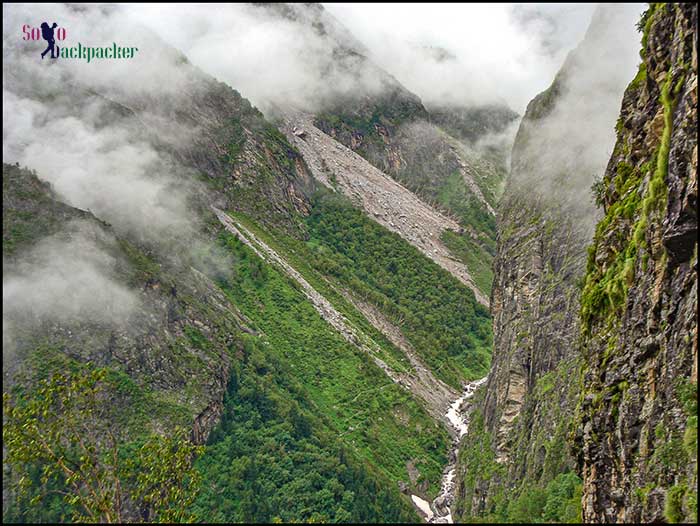
Looking back, the journey already felt full of experiences. Every place we visited brought a different feeling and a new perspective. Badrinath was about devotion. Mana brought a sense of curiosity. Vasudhara felt peaceful and humbling. And the Valley of Flowers was so beautiful that words hardly felt enough.
2. The Morning Dilemma at Ghangaria
After spending two days in Ghangaria, there was an irritating feeling of the place. The constant humidity, continuous rain, and cold mountain weather had worn us down. Wet clothes never seemed to dry, and everything felt damp all the time. In fact, we just wanted to pack our bags and leave the place as soon as possible.
More information about Ghangaria Village: Govindghat to Ghangaria Trek
But returning without completing the final part of our journey to the sacred Hemkund Sahib did not feel right. We could not leave without offering our prayers there.
When I woke up that morning, I was mentally preparing myself for the steep climb to Hemkund Lake. But when I looked at Nidhi, I realized she had a fever and was not in a condition to attempt such a difficult climb.
The trek to Hemkund Sahib is steep and demanding, with a climb of nearly 3,600 feet in just 6 kilometers. Doing that in fever and weakness was not safe.
I suggested that she take a pony for the trek, but she refused and asked me to go alone. She chose to rest. And I chose to continue the climb. With a heavy heart, I laced up my boots and stepped out of our hotel at Ghangaria.
3. Trek to Hemkund Sahib
I left Ghangaria at around 6:30 AM. The air was bitterly cold that morning. It’s important to leave for Hemkund Sahib as early as possible from Ghangaria. The mountains play by their own rules, and the weather here is highly volatile. The weather at the Hemkund Sahib changes rapidly in the afternoon. Thick fog, falling temperatures, and a drop in oxygen levels make it dangerous to stay late in the afternoon.
The trail from Ghangaria to Hemkund Sahib started with a steep climb almost immediately. Within a short time, my legs began to cry from the continuous uphill walk. I could see the ponies also struggling on the slippery and rocky path. I realized that riding a pony on this trail would not have been easy or comfortable either.
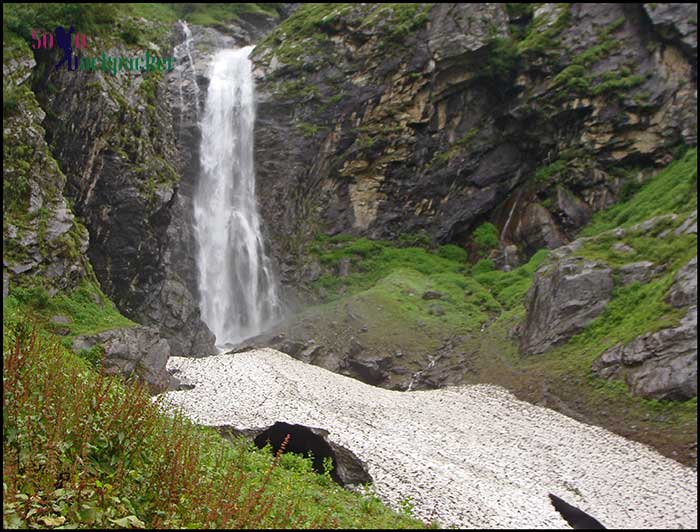
A day earlier, while returning to Ghangaria from the Valley of Flowers, we met an elderly Bengali couple who seemed very familiar with these mountains and trails. The uncle had said, “If the Valley of Flowers trek feels like a 6 months old baby, then the trek to Hemkund Sahib feels like a 60 years old man.” He was comparing the difficulty level of both the trails. As I climbed higher that morning, I realized how true his words really were.
Read about Valley of Flowers Trek: A Paradise on the Earth
I noticed a huge difference between this trek and the one to the Valley of Flowers. The Valley of Flowers trail had felt peaceful and quiet. It was like connecting with nature, where the only sounds were the wind and the distant flow of mountain streams.
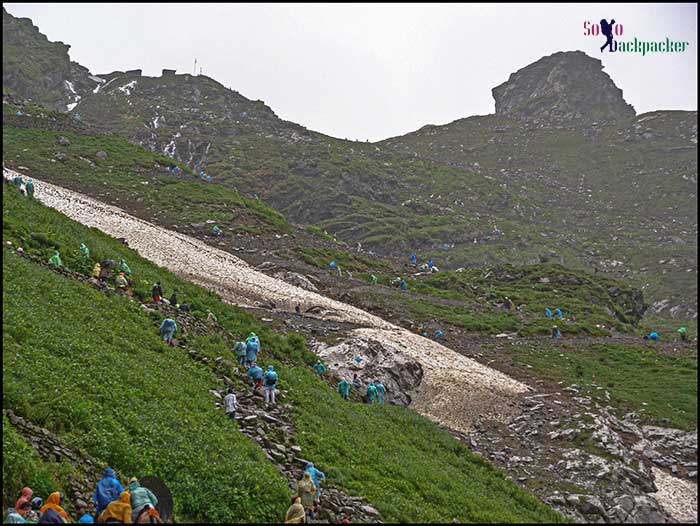
This path to Hemkund Sahib, however, was buzzing with life. The trail was completely full of pilgrims. Hundreds upon hundreds of men, women, children, and elderly folks (mostly Sardar ji) were trekking alongside me. Everyone looked exhausted, yet deeply determined to keep moving forward. The trail to Hemkund Sahib did not belong to hikers or tourists. It belonged to devotion.
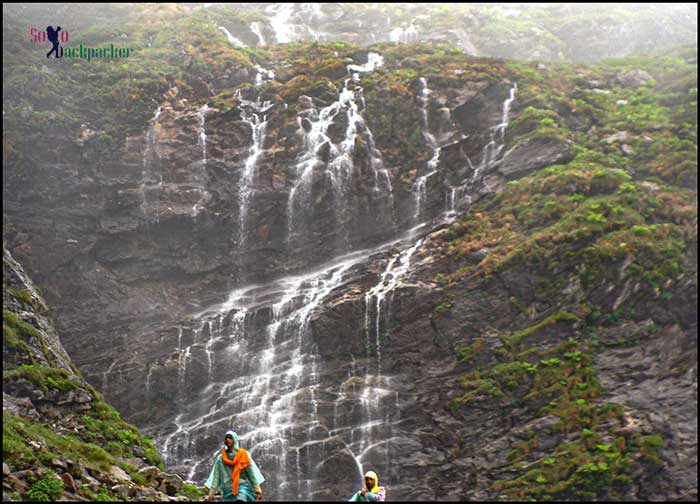
Despite the difficult trek, the trail is just as beautiful as the one leading to the Valley of Flowers. Tall mountains covered with lush green forests surround the path. During the monsoon season, many waterfalls can be seen along the way. Some are small and thin, some are frozen, while others cascade down the mountains in several streams together. The green valleys around the area look stunning from the trail to Hemkund Sahib.
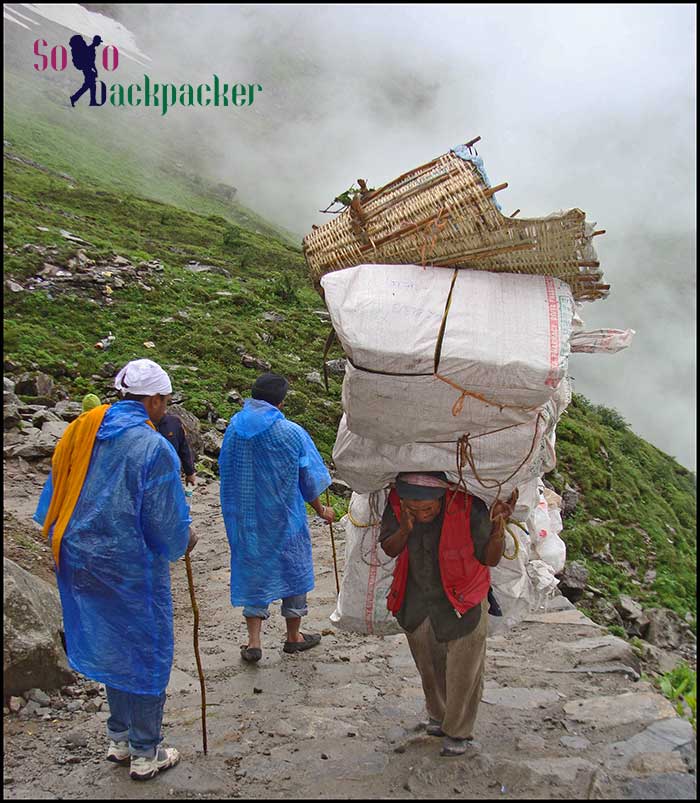
Rain is highly unpredictable here and can begin at any moment. To keep themselves safe from the sudden downpour, most of the pilgrims were wearing simple desi-made plastic ponchos (raincoats) bought locally.
The route features plenty of small, makeshift shops built along the edges of the trail. These stalls sold water bottles, packaged juices, hot tea, glucose biscuits, and simple snacks. Since all these items have to be carried up the mountain either by mules or by porters, everything is sold at a hefty, inflated price.
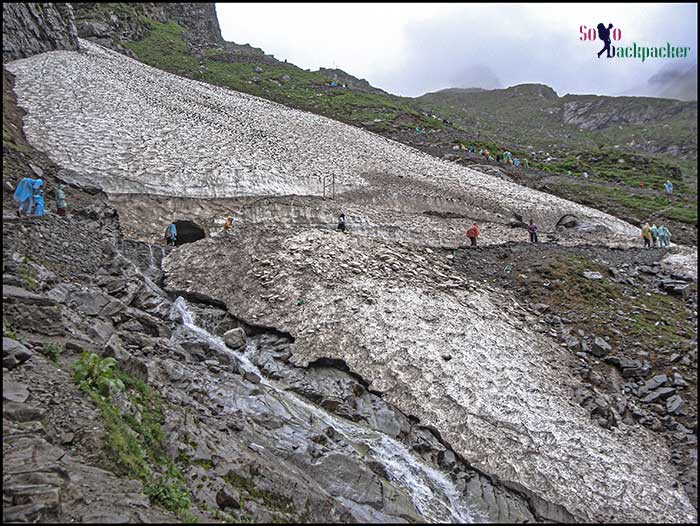
As I climbed higher, the green landscape slowly started disappearing, replaced by bare mountain rocks and patches of the snow. Soon, we came across a huge glacier stretching across the mountain from top to bottom. A narrow, slippery path had been carved directly through the thick ice to allow pilgrims to pass. Walking through this ice-cut channel was surreal.
I did not stop for long breaks and kept climbing at a steady pace. In exactly two hours, I reached the shores of Hemkund Sahib. Standing there and looking at the calm, untouched landscape, all the tiredness in my body and the intense cold seemed to disappear for a moment.
3.1 Hemkund Lake
Finally I was there, standing at a height of 15,200 feet above sea level. This is officially the highest Sikh shrine in the entire world.
The Gurudwara was located beside a beautiful crystal-clear glacial lake. Around it stood seven magnificent mountain peaks, surrounding the sacred place like silent guardians. On the top of each peak fluttered a Nishan Sahib, the sacred saffron flag of the Sikh faith, waving proudly in the cold mountain air.
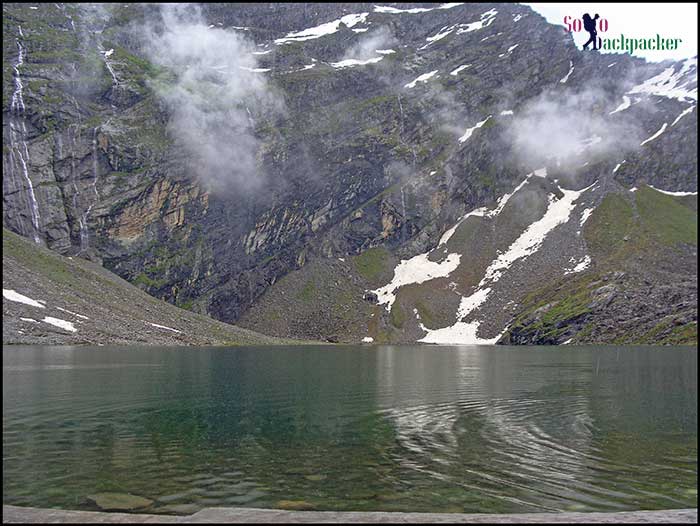
The water inside the lake was incredibly cold. It was fed directly by the melting snows of the surrounding glaciers. Despite the sub-zero temperatures and harsh wind, people were stripped down and taking full dips inside that ice-chilled water. The very thought of submerging my entire body into that lake sent a shiver down my spine. I simply could not gather the courage to take a full bath.
3.2 Lakshman Temple (Lokpal Hemkund)
While the majestic white structure of the Gurudwara dominates the landscape, there is another significant temple there. Lakshman Temple stands quietly near the lake, often overlooked by many people. Long before this site became a sacred destination for Sikh pilgrims, this lake was known to the hill people as Lokpal Lake. It is a place deeply connected with Hindu mythology and ancient Puranic legends.
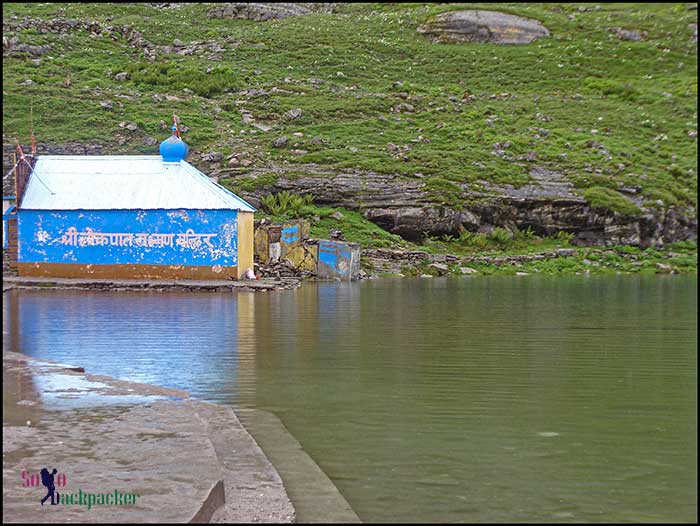
According to local beliefs, this is the exact spot where the younger brother of Lord Rama, Lakshman ji, came to perform deep penance. It is also believed that in one of his earlier divine forms, Lakshman ji existed as Vasuki Nag, the mythical serpent king known as Sheshnag. In that form, he chose this peaceful, snow-covered lake as a place to meditate and seek ultimate truth.
The small stone Lakshman Temple stands quietly beside the large Gurudwara complex. Nowadays, very few people seem to notice this ancient shrine. Only a small number of visitors enter the temple. Over time, the old temple appears to have lost much of its historical glory.
3.3 Shri Hemkund Sahib Ji
a) History of Hemkund Sahib
The modern history of the Gurudwara begins in the year 1930, with a man named Havaldar Modan Singh. He was a soldier belonging to the Bengal Sappers and Miners regiment of the British Indian Army, and he happened to be a part of an official survey team operating in these rugged, uncharted corners of the Garhwal Himalayas.
While trekking through this brutal, high-altitude terrain on duty, Modan Singh stumbled upon the hidden crystal-clear waters of Lokpal Lake. He wasn’t just a soldier; he was also a deeply religious man well-versed in the Sikh scriptures. As he stood on the shores, looking up at the unique geography of the place, something clicked in his mind. He realized that this hidden sanctuary perfectly fitted the vivid, poetic description laid out by the tenth Sikh Guru, Guru Gobind Singh ji, in his autobiographical composition, the Bachittar Natak. In that sacred text, the Guru describes that in his previous cosmic incarnation, he had performed intense, deep meditation at a place known as Sapt Shring, a beautiful lake encircled by seven distinct, snow-clad mountain peaks.
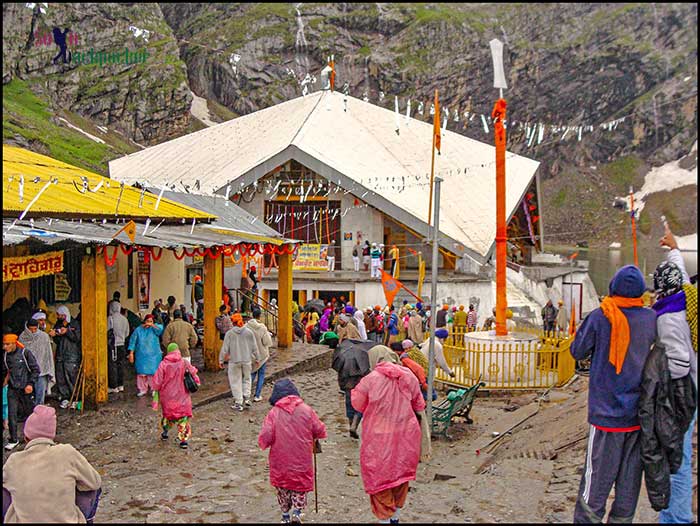
Havaldar Modan Singh dedicated himself to establishing a place of worship here. He teamed up with another fierce devotee, a retired army granthi named Sant Sohan Singh of Tehri Garhwal. Together, braving the lack of resources, extreme weather, and sheer logistical impossibilities, they managed to lay the foundation of the very first small Gurudwara in 1937 at the present location. From then on, the place came to be known as Hemkund Sahib.
b) The Gurudwara
Today, this remote mountainous terrain is recognized worldwide as one of the most famous and revered Sikh shrines. Every year, when the snowbound areas briefly open during the summer months, thousands of Sikh pilgrims from across India and around the globe undertake this beautiful journey in search of faith, devotion, and blessings.
I made my way inside the massive, uniquely designed white Gurudwara. The structure is built with a sloping roof designed specifically to withstand the crushing weight of winter snows.
As I stepped inside, I was immediately surrounded by the warmth of the crowded hall. At that moment, the morning Ardas was going on. The atmosphere felt deeply peaceful and powerful. Around me were hundreds of people—men with long wet beards, women covered in thick shawls, and small children with red cheeks from the cold weather. Everyone sat quietly, fully absorbed in the prayer. Watching them, I felt a sense of calm and togetherness that is difficult to explain in words. It made me realize how faith can connect so many different people in the same moment. This Ardaas is broadcast every day across India on the popular MH1 TV channel, but experiencing it there in person felt far more emotional and meaningful.
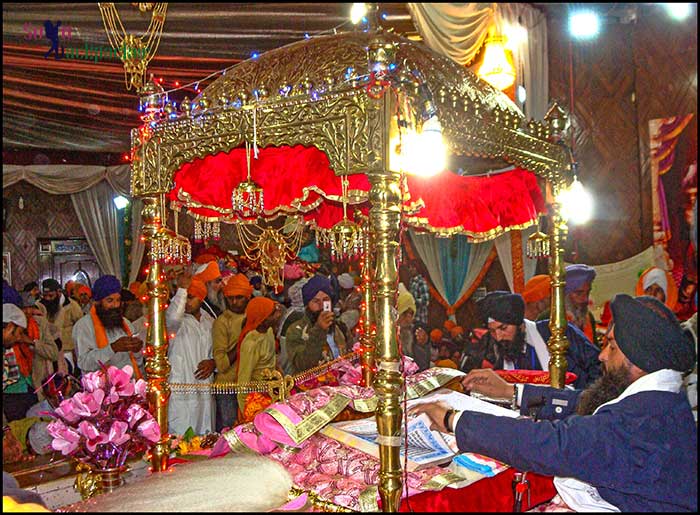
Once the long prayer ended, people slowly began to leave the hall. Most of the tired and freezing pilgrims made their way directly to the Langar, the community kitchen, to warm themselves with hot tea and a simple breakfast. After spending hours in the cold mountains, even this basic meal felt comforting and special.
I, however, decided to pass on the food for the moment. Instead, I preferred to pull out my camera and quickly clicked some photographs around the beautiful exterior premises.
As I stood there watching the tireless volunteers distribute food, I felt a deep sense of respect. At such a dangerous height, where even breathing feels difficult, they still manage to bring supplies, cook meals, and serve thousands of pilgrims with kindness and dedication. We should truly be grateful to them for their selfless service and dedication.
4. Facilities at Hemkund Sahib
4.1 Communication/Mobile Networks
Jio and BSNL networks are available on the 6-km trail, all the way from Ghangaria to Hemkund Sahib.
Read about another beautiful trek in Uttarakhand: Khaliya Top Trek
4.2 Medical Facilities
At an altitude of nearly 15,200 feet, the air becomes extremely thin, and acute mountain sickness can strike without warning. There are almost no proper medical or dispensary facilities available at Hemkund Sahib, while only basic medical help is available at Ghangaria.
In case of a serious emergency, patients usually need to be brought down to Govindghat for onward travel. However, the Uttarakhand Government also provides helicopter evacuation services from Ghangaria Helipad at nominal charges for emergency situations.
4.3 No Overnight Stay
There are no facilities for visitors to sleep at the top. The only people who remain are a very small skeleton crew of sewadars and security, and even they live in specialized, reinforced quarters. Everyone must start leaving the place by 0200 PM.
5. Return to Ghangaria
With one last look at the gurudwara behind me, I began my journey back down to Ghangaria. Descending the mountain felt like a completely different kind of challenge. There was no exhaustion or shortage of breath anymore, but the steep and never-ending downhill path put intense pressure on my knees and ankles.
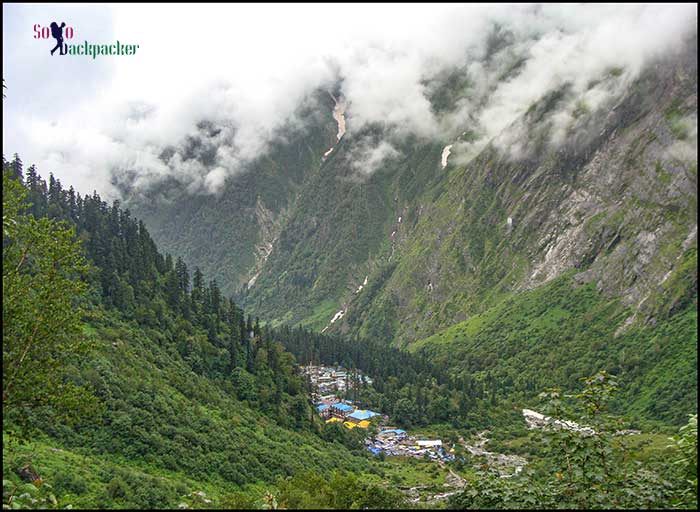
I reached Ghangaria in one hour, and with that, the journey finally came to an end. Nidhi was feeling much better and seemed cheerful at the thought of leaving Ghangaria the next day. I sat quietly in the room, trying to take in everything we had experienced over the past few days—the Valley of Flowers, the towering waterfalls, the lush green forests, the sudden mountain rains, the glaciers, the freezing water, the echo of prayers, and the small quiet temple standing peacefully beside the grand Gurudwara.

Very informative, thank you so much
Very useful information …..
very informative post.me & my wife also planning since last 3 years.after reading your post ,now we are sure that we can do this topur one day in 20`17.thanks.
Thank You very much– I take inspiration from your post— and plan to go there on 6th of July–I am 60 yrs old –do you have any suggestions.
That’s great Sir. It’s a high pilgrimage season for Hemkund Sahib. No specific suggestion from my side. I hope you will enjoy your journey. Have a nice trip 🙂
You have provided an extremely honest account of your tour, which shall be of immense help to me when I shall be travvelling to VoF, Hemkund Sahib and Auli this July, 2016.
Happy to have come accross your blog on this subject. I will be travelling with my family to Auli in May end for 6-7 days and in between from there will be making the side trip to Hemkund Sahib and VOF. My query to you is that can I do both these places in the same day once I have rested after the trek from Govindghat to Ghangria. Since they are very close by 6 and 3 kms away each way from Ghangria.
Hi, you can’t do both places in one day. Try to consider one day for VOF and another for Hemkund. Actually, VOF starts after 3 kms from Ghangaria, but to enjoy the beauty of valley, you have to go about 2 kms inside the valley.
Your posts from 2011 are inspiring in 2015 as well…quite interesting…i m planning to visit auli in december last week. Can I expect seeing snow around that time?
Thank you. Your timing is good to see snow in Auli and around. Have a nice trip. 🙂
Visited Auli, Deoriyatal and Chopta…had a tremendous time…do visit the blog to read about my experience. will look forward to ur advice and reading ur blog till further adventure 🙂
Thanks Nishant for visiting this blog. I will read your adventures surely. 🙂
hi dear, i am vivek. i am planning to go to AURI with family. can u suggest us teh best time to visit auli. other then this i also want to know, what is the attraction there for children because my children wants a tour in their summer vocation started from today itself.
You can visit Auli throughout the year. Every season has something different. In winter, it is fully covered by snow, and you can enjoy skiing etc. These days, snow is not there, but its a beautiful meadow with a scenic artificial lake. You can also hike to the nearby areas. Your children will enjoy the ropeway from Joshimath to Auli. If Auli only is not your target, you can visit Badrinath also from Joshimath. If you stay at Joshimath, you will get better hotels and reasonable prices. Make a day tour to Auli from there.
Hi,
Love your write-up of the trips. It was very informative. I am from Malaysia, keen to visit the Hemkund Sahib in April. Is it a good time for hiking up to the gurudwara, in term of difficulties caused by the weather conditions. Also, will there be many pilgrims as encountered by you (for me, the more the merrier) during this period? Is the Rp600 fee chargeable for this hike?
Hi, I don’t think that Hemkund Sahib will be open by April, may be by May End. In April, there will be lot of snow. Once the route and Gurudwara opens, hundreds of pilgrims flock daily. Its really a huge crowd at Hemkund Sahib in the season. There is no charge for hike upto Gurudwara. The basecamp for the final hike is Ghangaria Village. From Ghangaria, one route goes towards Hemkund Sahib, while other one towards the Valley of Flowers, a paradise. You have to pay entry charges for Valley of Flowers, as it is a national park.
thanks for the info.
hi dear u r great. u planned trip well at right age that too with life partner.i too plnning same trip and as godsent i stumbled upon ur seril 5 parts.beautiful tips and simple naration.by the by what camera u used,exlent capturing.next do trek to nandadevi sanctury,gangotri glacier and tapovan.u wil enjoy.u can see good pictures in american alpine club website donated by legendary our harish kapadia.read wanderings in himalayas by tapovanmaharaj,and swami sunderananda book cliking swamys himalayas[pictures] u can get from chinmayatrust anywhere.my blessings to u.i completed kailashmansarovar parikrama,kedar-bhadri dhams and planning to muktinad in nepal
I am thinking about the Gangotri Glacier and Tapovan..Hope I will be there soon.
Loved your account. Isn’t Hemkund the place where many skeletons, probably of a lost army were found ? Lovely pics btw 🙂
Hi, Thanks for loving it. Hemkund is not the same place you are talking about. That place is known as Roopkund, also in Uttarakhand.