

Contents
1. The Legacy of Old Tehri
There are some places that could not survive the test of time. Some disappeared because of natural forces — like Dwarka, which is believed to have submerged beneath the sea. Some were abandoned, like Fatehpur Sikri, the sprawling capital built by Akbar. And there are places whose history was reshaped by massive and ambitious development projects — places like Old Tehri.
Old Tehri was once a quiet town nestled in the lap of the Himalaya, where the emerald waters of the Bhagirathi and Bhilangna rivers embraced each other before continuing their long journey through the mountains of Uttarakhand. Today, the town survives only in memories and fragments of history, forever etched in the minds of those who once called it home.
If you stand on the banks of the vast Tehri Lake and gaze into its still waters, it becomes difficult to imagine that beneath this shimmering blue expanse once existed a living town filled with bustling bazaars, narrow lanes, temples, homes, laughter, and generations of stories.
Old Tehri was not merely a town. Long before its submersion under one of India’s largest hydroelectric projects, Tehri had already become a symbol of resilience and environmental consciousness because of the historic Chipko Movement led by Sunderlal Bahuguna.
During the movement, villagers — especially women — hugged trees to protect the forests from ruthless cutting. The movement was not only about saving trees; it was about preserving a way of life and safeguarding the fragile relationship between humans and the mountains they called home. In many ways, Old Tehri became one of the enduring symbols of that awakening.
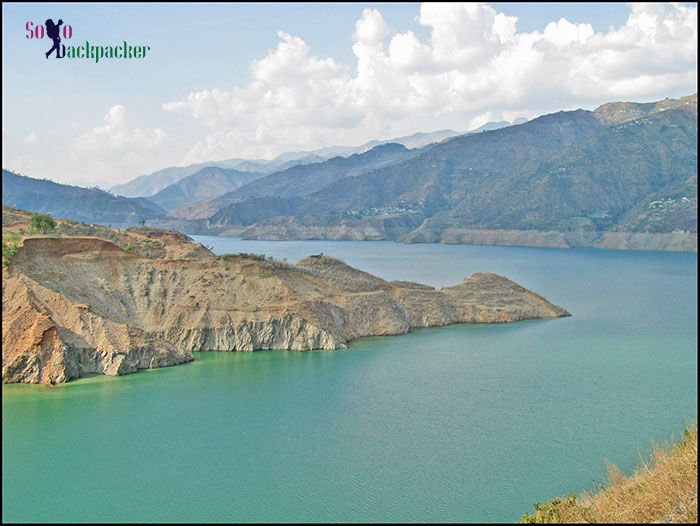
But history often moves with a strange irony. The very land that once inspired a movement to protect nature was later chosen for the India’s most ambitious hydroelectric projects. As plans for the Tehri Dam gained momentum, uncertainty slowly settled over the town like winter fog over the hills. Protests were raised, voices trembled with fear and anger, and many residents fought desperately to save their homes and heritage. But despite all the resistance, it slowly became clear that the fate of Old Tehri had already been decided.
Gradually, Old Tehri disappeared beneath rising waters of Bhagirathi River. Streets vanished. Temples drowned. Courtyards where children once played slipped silently into the depths. The confluence that had nurtured the town for centuries transformed into the immense Tehri Lake — now known as Asia’s largest man-made lake. The people of Old Tehri were relocated to New Tehri, carrying with them fragments of a submerged past that no rehabilitation colony could truly replace.
Today, Tehri Lake has developed into a major tourist attraction and water sports destination. But if you speak to the older residents, many of them still talk about Old Tehri with a distant look in their eyes, as if remembering a dream that ended too soon. They recall the sound of temple bells echoing across the valley, the busy markets during festivals, and the familiar mountain paths that no longer exist. Beneath the calm waters of the lake lies not just a lost town, but an entire chapter of Himalayan history — resting silently under the water.
2. Planning the Visit from Rishikesh
When I was living in Dehradun, visiting Tehri Lake was always somewhere in my mind. I had heard so much about the old town of Tehri and the huge lake that had taken its place, but somehow the trip never happened. Days passed, plans changed, and Tehri remained one of those places I quietly wished to see someday.
Read more about Rishikesh: A Morning Stroll Along The Ganges in Rishikesh
Later, during a visit to Rishikesh, I finally decided that I should not miss the chance again. Early in the day, I reached the Rishikesh Bus Stand with excitement and curiosity in my mind, hoping to find a direct bus to Tehri. But like many journeys in the mountains, things did not go exactly as planned. There was no bus available for the next one hour.
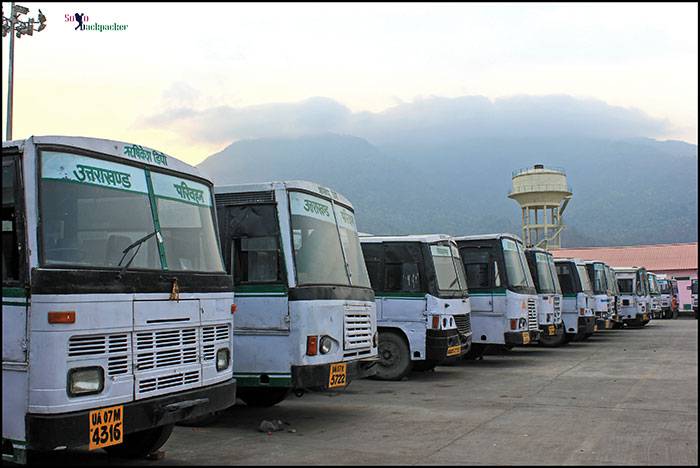
For a moment I thought of waiting, but then I decided to continue the journey in whatever way possible. I boarded a bus going to Chamba, a small hill town around 60 kilometers from Rishikesh and nearly 15 kilometers before Tehri Lake. The ticket cost only Rs. 38, but for me, the journey felt much more valuable than that.
3. Journey from Rishikesh to Chamba
As the bus left Rishikesh behind, the road slowly started climbing into the hills. It was an uphill ride on smooth winding roads that curved around the mountains. The bus moved slowly but steadily, making its way higher into the Shivalik hills.
From many points on the road, I could see Rishikesh far below, with the Ganges flowing quietly through the city. The view became more beautiful as we moved ahead. The bus passed through dense forests, deep valleys, and small villages surrounded by green terraced fields. The hills looked fresh and full of life. Cool mountain air entered through the bus windows, and the whole journey felt peaceful and refreshing.
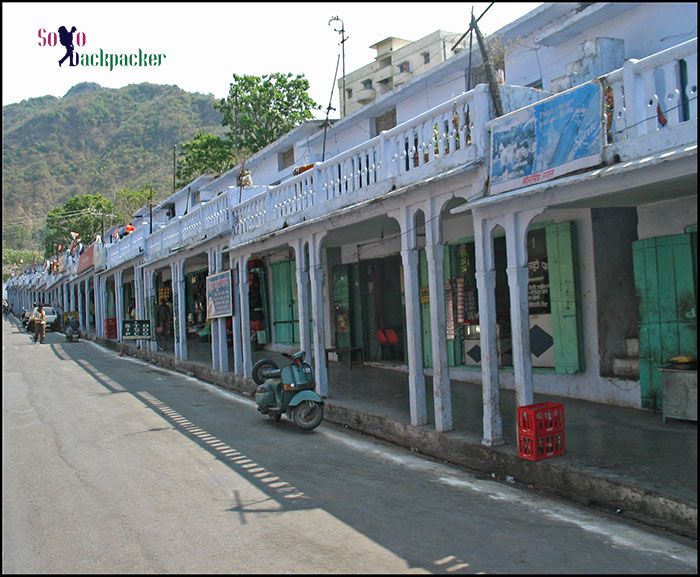
On the way, the bus crossed Narendra Nagar, a beautiful small town about 16 kilometers from Rishikesh. The town looked neat and charming. Its main market, with rows of white buildings along the road, reminded me of a small and quiet version of Connaught Place in Delhi. After a short halt there, the journey towards Chamba continued through the beautiful mountain roads leading towards Tehri.
4. Arrival at Chamba & The Uncertain Next Step
I reached Chamba around 1 PM. It is a small but important hill town where four roads meet—one from Rishikesh, one towards Mussoorie via Dhanaulti, one going up to Uttarkashi and Gangotri, and another leading towards Tehri Dam. Because of this, Chamba feels like a quiet junction in the mountains where many journeys pause for a while.
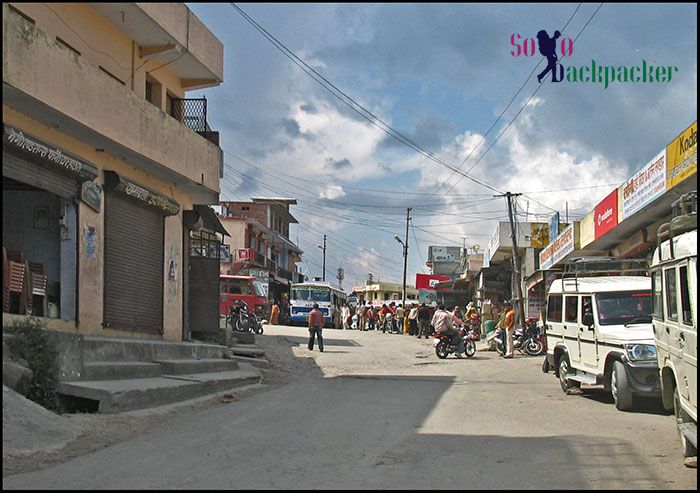
As soon as I arrived, I realized that reaching Tehri from here would not be so simple. There was hardly any regular bus service towards Tehri Dam. In fact, only one bus was scheduled in the morning, and I had already missed it. So I was left waiting in Chamba with no clear plan for the next step.
The only other option was shared jeeps like Sumos or Marshals. But even that turned into a long wait. One jeep driver was there with few passengers but he insisted on filling the vehicle with almost 20 passengers before starting the trip. The fare was just Rs. 20 for about 20 kilometers, but the driver refused to move until it was fully packed. Around 14 of us were already there, waiting under the sun, but nothing was happening.
Read about Kedarkantha Trek, a popular winter trek in Uttarakhand: Kedarkantha Trek Guide: My Journey Back to the Himalaya
After some time, frustrated passengers slowly began walking away, and soon the jeep became almost empty again. Just when I was wondering what to do next, another jeep suddenly arrived. It was not supposed to pick up passengers from there, so the driver seemed in a hurry. He quickly picked whoever was waiting and moved forward to avoid any issues with the local jeep drivers. Finally, I got a seat, and we started the journey from Chamba towards Tehri.
5. Descent to the Submerged City
From Chamba, the journey towards Tehri felt more adventurous. We moved slowly along narrow mountain roads, going deeper into the hills. The road was not in very good condition, but the surroundings made up for it completely. Green mountains, fresh air, and quiet valleys were all around.
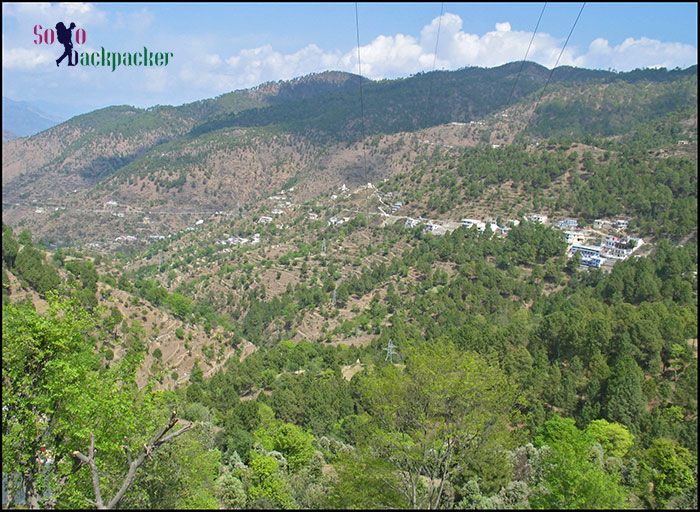
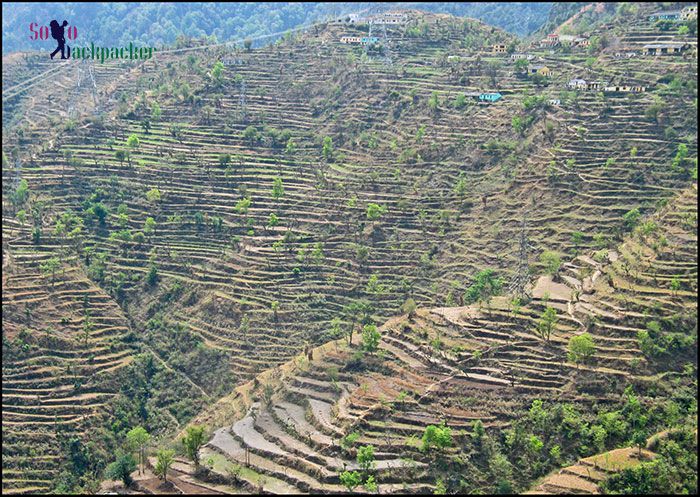
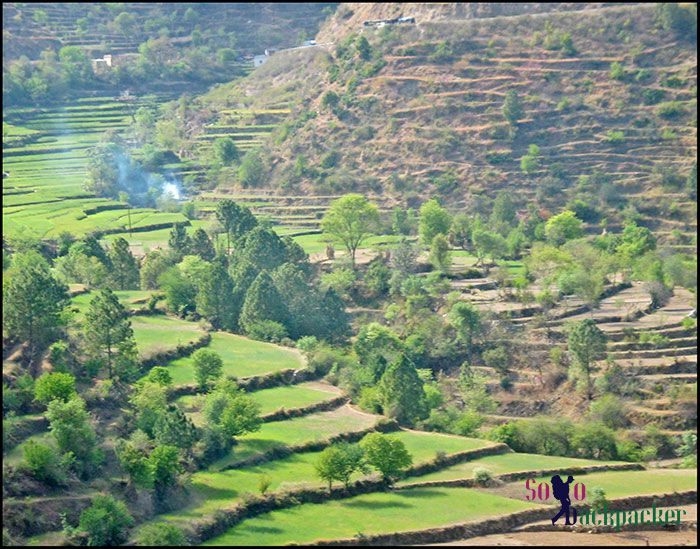
As we travelled further, I could see beautiful terraced fields on both sides of the road. The hills looked like they were carefully carved step by step for farming. It was hard to imagine how much effort people must have put into shaping such steep land into usable fields. The scenery felt calm and timeless.
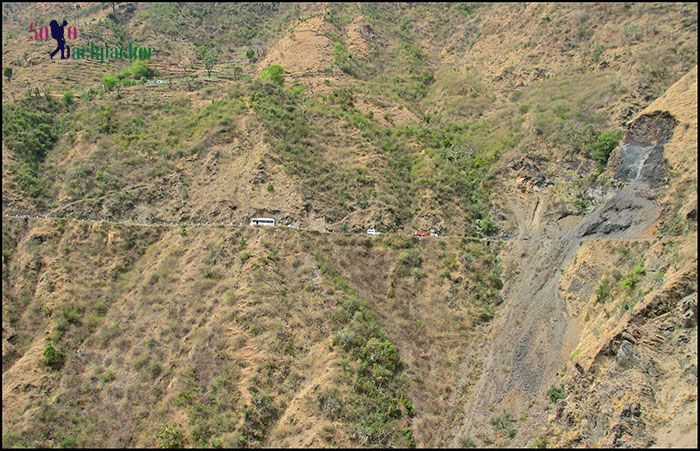
There is actually no place now called Old Tehri. The original town has completely gone under water after the dam was built. So the road does not lead to the old town anymore. Instead, we were going towards Koti Colony, which lies on the edge of Tehri Lake and serves as an entry point to see the area where Old Tehri once existed.
As we moved closer, the feeling slowly changed. I started thinking about the fact that beneath the vast water spread in the valley, there once stood a full town with homes, markets, and people living their everyday lives. Now everything was silent under the lake.
6. At the Edge of Tehri Lake
Finally, around 3:00 PM, I reached Koti Colony. The place felt quiet, sitting on the edge of the huge Tehri Lake. In the jeep, I met a local boy, around 14–15 years old. He was friendly and full of energy. He started showing me around and telling me whatever he knew about the area—the dam, the lake, and the old town of Tehri that once existed here.
He was too young to truly understand the full history, the long protests, or the deep emotions connected to this project. But he spoke with excitement, as if he wanted to share everything at once. He showed me the road that once led to Old Tehri, the place where the old bus stand used to be, the helipad, and the massive dam site. Down below, I could see scattered machines—old bulldozers, concrete mixers, and trucks. They looked like forgotten pieces of a huge construction story. Everything lay silent now, as if work had paused long ago.
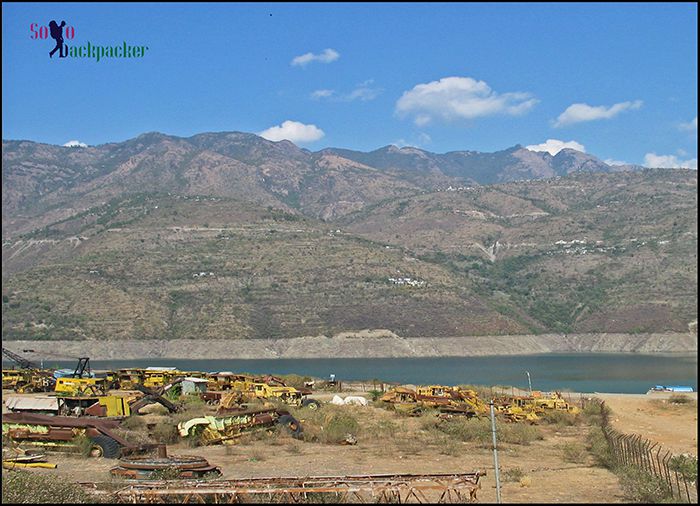
As he kept talking, I stood there quietly, looking at the lake. Standing at the edge of Tehri Lake, it felt as if time had stopped. Once, at an altitude of about 755 meters, Old Tehri stood here as a living town. In 1803, it became the capital of Tehri-Garhwal under Maharaja Sudarshan Shah. Today, that dreamlike town survives only in memories, faded photographs, and beneath the quiet waters of the lake.
7. The Tehri Dam: A Feat of Engineering
On the way up towards the dam, there is a viewpoint at a place called Bhagirathipuram. It also has a small bus stop. From here, you get a wide panoramic view of the entire Tehri Dam. A board of the Tehri Hydro Development Corporation welcomes visitors and gives basic information about the project.
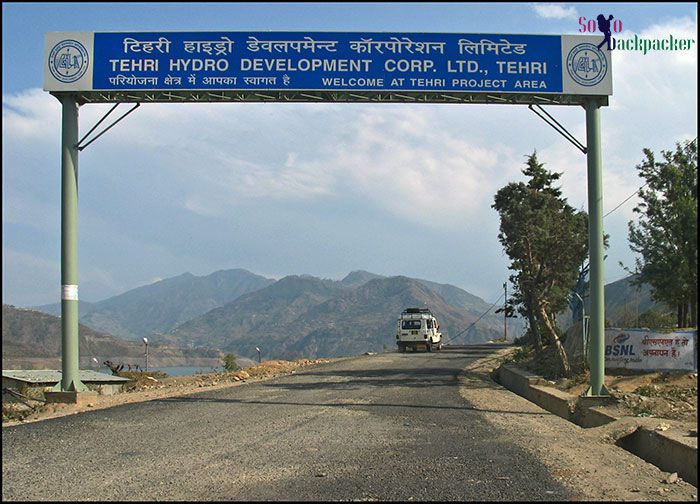
Standing there, the scale of the Tehri Dam is hard to believe. It is one of the largest hydroelectric projects in the world. The main dam rises 855 feet high, making it the tallest dam in India and among the tallest in the world. The project generates around 2400 MW of electricity and was designed not only for power generation, but also for irrigation and water supply. Today, it helps provide drinking water to cities across Uttarakhand, Uttar Pradesh, and Delhi. As part of the same project, another dam was built downstream at Koteshwar Dam, about 14 kilometers away. It is around 97 feet tall and contributes another 400 MW of power generation.
A beautiful trek to Dzukou Valley in North East India: Trekking To The Dzukou Valley in Nagaland
But behind this massive engineering achievement lies a deeply human story. More than one lakh people were displaced because of the project. Entire families had to leave behind their homes and ancestral land. Old Tehri and around 40 nearby villages were completely submerged under water, while many other villages were partially affected. The dam also stands in a highly sensitive Himalayan earthquake zone, which has remained a major concern for environmentalists and many local residents for years.
8. Back to Dehradun
After spending almost an hour near Tehri Lake and the dam site, I slowly started my journey back. An almost empty bus arrived for Chamba, and this time I was the only passenger inside. The quiet ride through the hills felt peaceful and a little emotional. Outside the window, the evening light was slowly fading over the mountains, and the valleys were becoming silent.
As the bus moved through the winding roads, I kept thinking about Old Tehri—the town that once existed here and now sleeps beneath the waters of the lake. The journey no longer felt like just a trip to a tourist place. It felt like visiting a memory hidden inside the mountains.
By around 6 PM, I reached Chamba again. From there, I found a shared cab to Rishikesh. The roads were darker now, and the cool mountain air carried the tiredness of the long day. After reaching Rishikesh, I boarded a bus back to Dehradun and finally reached my friend’s room around 10 PM.
It had been a long journey through the Shivalik Hills, filled with buses, mountain roads, waiting, and unexpected moments. But somewhere deep inside, I felt happy that I had finally seen Tehri with my own eyes. That Saturday was not just another weekend trip—it became one of those journeys that stay quietly in memory for years.

One of the best place of my life…I spent a month in Chamba and I never forget that time
On the way of return journey from Gangotri I had a glimpse of Tehri Dam. It’s so huge that it took at least half an hour to drive along its side. We found water sports and hotel facilities available in the dam. While searching internet I found that Tehri Dam made the entire zone earthquake prone. May be it’s for human benefits but future days will judge its utility.
Myself and my wife visited on 4th of Dec. from Dehradun to Tehri Dam. It’s my third visit to Dam, and every visit I feel different feeling one way I think about nature, other way the “Man-Power “ who dare to convert the nature into a Man paradise.
Its beautiful after visit the memory keeps you fresh for several days, A thought keeps you busy to plan for next visit.
Old tehri was extremely beautiful city , my father got transferred to old tehri in the year 1979 , I studied there for sometime in ggic girls school , now it is hard to believe that ggic school , my beautiful school is actually under water , and still exists .
I am from Chamba, yet I have seen love and pain in eyes of friends who hailed from Tehri. I do lived their dreams and fears when Tehri was submerging. I have studied in New Tehri (All Saints Convent school) which later allowed all the children’s from old tehri Convent school.
Tehri is not just a Dam filled with water, its love and pain of thousands of residents and locals which with time has been submerged somewhere deep in their hearts. A sad side of so called Development Coin.
God bless you Tehri, long live. we are proud of you.
–Atul Negi
Your blog helped. There is a water-sport hub coming up in Panch Koti downhill from the viewpoint. We had fun.
I stayed in Old Tehri Town till 1987. I went to All Saints Convent School there till my 3rd Standard. I have very sweet memories of that place and still lives deep inside. Thanks for posting this article. Lived a day by sharing your memories shared in the article. Do keep posting. Thanks and best regards. Prashant
I was also thr in 1978..my uncle..first posting was thr on Tehri Dam project..vnha pr ek kila bhi tha…uske neeche government employees..in Dam project..quarters thei..pass mei mera addmission hua tha…Convent school mei
Ek saal baad mera addmission hua Ghanta ghr k pass Sarashvati sishu mandir vidhyalaya mei…aaj maine vo sb din yaad kiye…pass mei sarkari hospital..Mata mehel…neeche market…
I spent my early childhood in Tehri from birth till 3rd grade. We used to live at Purana Darbar. Most amazing days of my life!
very good and detailed information with pics……….. well done.
The lake is pristine and beautiful. Nice post.